

Table of Contents
Canadian startups entering enterprise markets face increasing security requirements from potential customers who refuse to sign contracts without verified controls. SOC 2 compliance establishes a recognized framework that demonstrates your organization manages customer data securely and maintains operational availability. This certification often serves as the primary gatekeeper between early-stage traction and scalable enterprise revenue. This article explains how SOC 2 works, why delaying it creates technical debt, how to leverage it for faster sales cycles, and the strategic steps required to achieve certification efficiently.
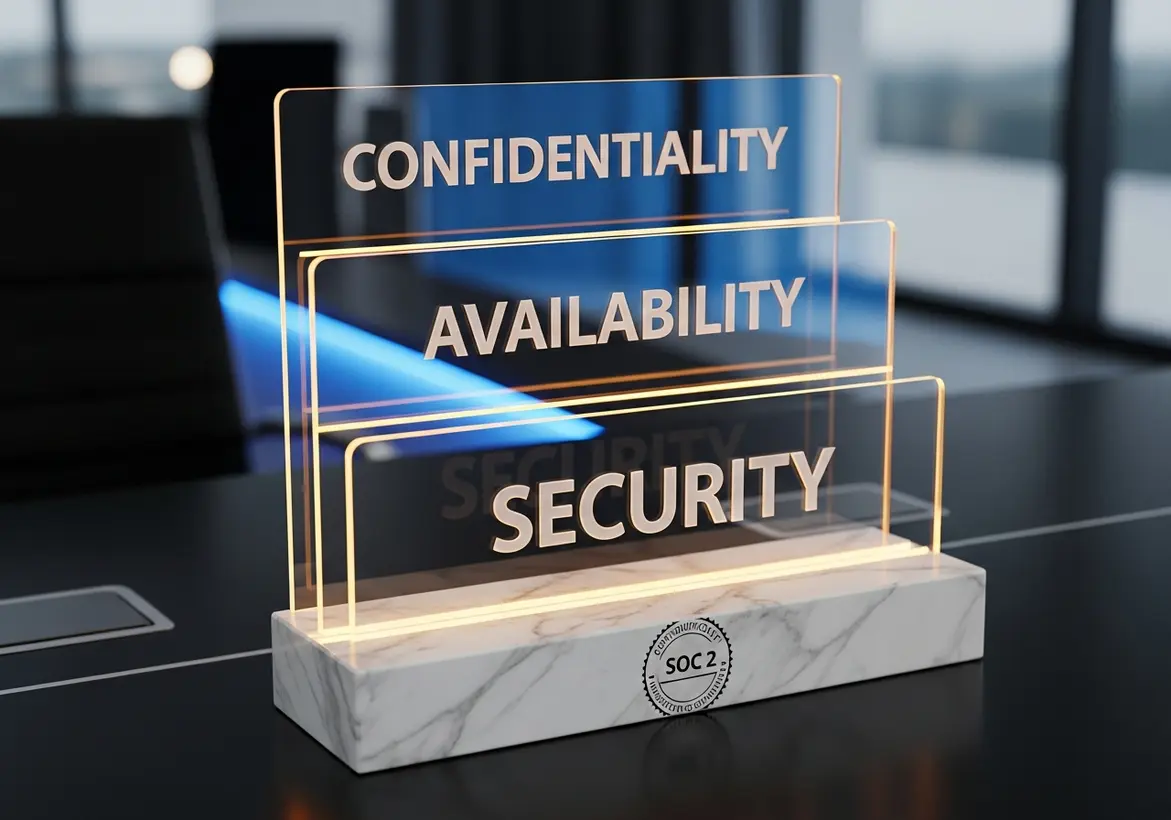
Understanding SOC 2 fundamentals 🎯
SOC 2 is not a certification you hang on the wall like a diploma. It is an attestation report that details your operational reality and validates that your service organization controls manage customer data securely. The framework operates on five Trust Services Criteria, which include Security, Availability, Processing Integrity, Confidentiality, and Privacy. Security serves as the only mandatory criterion, often referred to as the "Common Criteria," while the others remain optional based on your specific business model and customer requirements. When you pursue SOC 2 certification, you commit to a process of defining policies, implementing technical controls, and providing evidence that an independent auditor reviews to issue your final report.
Most founders encounter two variations of this report, and understanding the difference saves significant time. Type I evaluates the design of your controls at a specific point in time, verifying that your system is set up correctly to meet the criteria. It represents a snapshot that proves you have built the necessary engine. Type II evaluates the operating effectiveness of those controls over an observation period, proving that you maintain security standards consistently over time. While Type I offers a faster initial milestone, enterprise customers increasingly demand Type II reports to ensure your security practices remain active when no one is watching.
"Security is not a product, but a process." - Bruce Schneier. This principle defines effective security compliance. Startups that treat SOC 2 as a continuous habit rather than a one-time act build systems that scale effortlessly as they grow. The certification process forces you to look at your organization through a lens of risk management rather than just feature velocity.
Accelerating enterprise sales cycles 🚀
Enterprise procurement teams utilize security questionnaires as gatekeepers for vendor approval. Without a verified report, your sales team faces the arduous task of answering hundreds of security questions manually for every potential deal. This often traps founders and lead engineers in endless spreadsheet battles instead of building a product or closing deals. A SOC 2 report acts as a master key, allowing you to bypass extensive questionnaires and move directly to contract negotiation. The time saved here translates directly to shorter sales cycles and reduced friction in your revenue pipeline.
One seed-stage fintech platform handling payment processing achieved both ISO 27001 and SOC 2 Type 2 certifications through parallel implementation. By leveraging the significant overlap between frameworks, they enabled enterprise payment processing contracts that were previously blocked by security requirements. Rather than waiting for a customer to demand compliance, they prepared their security posture in advance, allowing them to capitalize on opportunities the moment they arose. This strategic foresight meant they could answer "Yes" to security requirements immediately, preventing the momentum loss that kills enterprise deals.
Pro tip: Most startups need Type I within months to close their first enterprise deal—start gap analysis the moment you enter enterprise sales conversations rather than waiting for customer demands.
Building operational maturity 🏗️
Implementing SOC 2 controls forces early-stage companies to move beyond ad-hoc processes that rely on individual heroics. You establish formal policies for access control, implement structured change management, and document evidence that auditors require. This transition from "move fast and break things" to "move fast with guardrails" reduces the risk of outages and data breaches that can damage a young company's reputation. It compels you to define who has access to production data, how code moves from staging to production, and how you monitor for anomalies.
Operational maturity also streamlines employee onboarding and offboarding, which becomes critical as you scale headcount. Instead of relying on tribal knowledge or founder memory to grant and revoke access, you utilize defined procedures that ensure security and consistency. This systematic approach reduces the cognitive load on founders, allowing them to focus on product strategy rather than administrative firefighting. You create a structure where security responsibilities are distributed and documented, preventing the bottleneck that occurs when the CTO is the only person who understands the infrastructure.
The result is a more resilient organization that withstands scrutiny. When an incident occurs - and in technology, incidents are inevitable - you have an incident response plan ready to execute. You possess logs to analyze what happened. You maintain backups to restore critical data. These elements transform a potential operational issue into a manageable event that doesn't derail your business continuity. Instead of seeing compliance as a constraint, see it as the operational scaffolding that allows you to build higher without collapsing.
Satisfying investor due diligence 💼
Investors view unmanaged risk as a valuation killer. When venture capital firms conduct due diligence for Series A or B rounds, they scrutinize your intellectual property protection and data governance practices. A startup with verified security controls demonstrates that the founding team understands enterprise risk and has built a scalable foundation. This maturity signals to investors that their capital will fuel growth rather than clean up security debt or pay for data breach remediation. It answers the question of whether your technology stack can handle the compliance requirements of the Fortune 500 customers projected in your pitch deck.
Integrated compliance implementation builds on previous certifications to satisfy these investor requirements efficiently. One AI startup leveraged its ISO 27001 foundation to accelerate readiness for comprehensive compliance certifications, including SOC 2 and GDPR. This strategy allowed them to complete investor due diligence that would typically consume weeks of founder time, proving that their governance structure was ready for rapid scaling. By proactively addressing compliance, they removed a significant friction point in their fundraising conversations.
Founders who build security practices, maintain compliance documentation, and demonstrate continuous improvement position themselves for successful fundraising rounds. The documentation you prepare for auditors serves double duty as the evidence room for investor queries. This efficiency prevents the last-minute scramble to prove your company is investable, allowing you to focus the conversation on growth metrics and product vision rather than risk mitigation.
Reducing technical debt 📉
Technical debt in security is significantly more expensive to fix than technical debt in code. Building a product without access controls, encryption, or audit logs requires a massive engineering overhaul to retrofit later. Engineers often have to rewrite core architecture to accommodate security requirements that could have been included in the initial build. For example, retrofitting database encryption or separating tenant data in a multi-tenant architecture can halt feature development for months if not addressed early.
By adopting SOC 2 principles early, you bake security into your development lifecycle. You implement code review processes, vulnerability scanning, and secure deployment pipelines as standard practice. This proactive approach avoids the "security tax" that hits late-stage startups trying to IPO or exit, where remediation costs can balloon significantly. It ensures that every line of code written contributes to a compliant system rather than a future liability.
Pro tip: Use automated evidence collection tools—manual screenshot gathering consumes significant preparation time that could be spent on implementation.
Instead of seeing early compliance as a resource drain, see it as an insurance policy against future re-engineering costs. The founder who prioritizes secure architecture from the start invests resources efficiently. They avoid the painful reality of having to pause product innovation to fix fundamental security flaws that threaten the company's existence.
Leveraging competitive advantage 🏆
In a crowded market, trust becomes a primary differentiator. When a prospective customer compares your solution against a competitor's, the existence of a SOC 2 report can be the deciding factor. It signals that you respect their data and have invested in protecting it. This is particularly vital for Canadian startups selling into the US market, where SOC 2 is effectively the baseline requirement for doing business. Without it, you are often automatically disqualified from RFPs regardless of your feature set's superiority.
Market differentiation goes beyond just having the badge. You can market your security posture as a feature. Sales teams armed with compliance reports speak confidently about data protection, turning security conversations from defensive justifications into offensive value propositions. This confidence resonates with buyers who are personally liable for vendor risk management. You shift the conversation from "Is this safe?" to "How quickly can we deploy?" because the trust barrier has already been lowered.
Startups that pursue SOC 2 certification early position themselves as enterprise-ready partners. They signal to the market that they are not just a risky experiment, but a stable vendor capable of serving large clients. This perception often allows smaller startups to punch above their weight class and win deals against entrenched incumbents who may have become complacent about their security posture. Instead of treating security as a checkbox, treat it as a trust framework that strengthens your market position.
Planning your certification roadmap 🗺️
The journey to certification begins with a gap analysis. This assessment compares your current practices against the Trust Services Criteria to identify what is missing. From there, you build a remediation plan that prioritizes critical controls. Most startups begin with a Type I report to establish a baseline before moving to the observation period required for Type II. This roadmap allows you to demonstrate immediate progress to customers while building toward the more comprehensive operational validation.
Successful founders treat this roadmap as a core business objective. They assign ownership of controls to specific team members, integrate compliance tasks into their project management tools, and review progress alongside product milestones. They understand that security is not a project with an end date, but an ongoing operational state. The founder who approaches security controls with systematic documentation does more than satisfy auditors. They build operational resilience that scales.
For companies with broader ambitions, this roadmap often intersects with other standards. Many founders choose to align their SOC 2 efforts with ISO 27001 certification to cover international markets simultaneously. The controls overlap significantly, allowing you to achieve dual certification with only incremental effort. This efficient approach maximizes the return on your compliance investment.
Pro tip: Run SOC 2 and ISO 27001 in parallel if targeting international markets—framework overlap means minimal duplicate work when properly coordinated.
FAQs ❓
* How much does SOC 2 certification cost?
Costs vary based on company size, complexity, and scope. Book a consultation for pricing tailored to your specific infrastructure and needs.
* How long does the process take?
Timelines depend on your current security posture and the report type (Type I vs Type II). Schedule a call for a customized roadmap and timeline estimate.
* What is the difference between Type I and Type II?
Type I tests the design of your controls at a specific point in time. Type II tests the operating effectiveness of those controls over a sustained period.
* Can we do this ourselves without a consultant?
While possible, self-implementation often leads to over-engineered controls or audit failures. Expert guidance streamlines the process and ensures controls are designed correctly the first time.
* Do we need SOC 2 if we are a small team?
Yes, if you plan to sell to enterprise customers. Size matters less than the data you handle; even small teams need verified controls to win big contracts.
Book a free consultation 📞
Ready to accelerate your enterprise sales cycle? EIM Services specializes in helping Canadian startups navigate SOC 2, ISO 27001, and other compliance frameworks without the fluff. We understand the specific constraints of high-growth companies and design security programs that enable business rather than blocking it.
Book a free consultation today to discuss your certification roadmap and learn how we can help you build a security posture that wins deals.
Oleg
Co-Founder @ EIM
Serving the startup community since 2024
20+ years in Enterprise
EIM Services has partnered with multiple Canadian and International startups to deliver scalable, cost-effective, and solid solutions. Our expertise spans pre-seed to Series A companies, delivering modern continuous certification and compliance solutions tailored for Startups in the cost-effective and shortest possible time. As well as bringing automated financial systems that reduce financial overhead by an average of 50% while ensuring investor-grade reporting at a fraction of the cost of an in-house team. We've helped startups save thousands through strategic financial positioning and compliance excellence.
