

Table of Contents
Canadian startups targeting enterprise customers face a practical question: Do you need both SOC 2 and ISO 27001, or will one certification satisfy your market? The answer depends on geography and customer base, but the real opportunity lies in recognizing that these frameworks overlap significantly. Rather than choosing between them, successful founders build roadmaps that achieve both certifications with minimal duplicate effort. This article explains how SOC 2 and ISO 27001 differ structurally, when you'll need each certification, and how to sequence your implementation for maximum efficiency.

Understanding framework differences between SOC 2 and ISO 27001 🎯
SOC 2 and ISO 27001 approach security from fundamentally different angles. SOC 2 evaluates whether your startup demonstrates effective controls across five Trust Service Categories: security, availability, processing integrity, confidentiality, and privacy. An external auditor validates that your controls operate effectively during a defined observation period, typically six months for Type II reports. The framework focuses on current control effectiveness for service organizations.
ISO 27001 establishes an information security management system across your entire organization. Rather than auditing current controls, ISO 27001 requires you to document policies, implement controls systematically, and maintain continuous improvement processes. The framework prescribes 114 controls organized into 14 domains, giving you a comprehensive security blueprint that demonstrates systematic governance. This structural difference explains why they appeal to different audiences - North American enterprise customers typically demand SOC 2 compliance during vendor evaluation, while European and international customers require ISO 27001 certification as a baseline for engagement.
When startups need both certifications simultaneously 📊
Your market composition determines certification priority. If your customers are primarily North American SaaS, fintech, or healthcare companies, SOC 2 certification becomes your immediate priority. North American enterprises expect SOC 2 reports during vendor evaluation, while ISO 27001 remains secondary unless your contractual relationships extend to European markets. Startups with European customers or international growth plans need ISO 27001 alongside SOC 2.
As explored in Why startups need SOC 2 sooner than they think, the sequencing matters: you'll pursue SOC 2 first to satisfy North American customers and investors, then layer ISO 27001 certification to unlock European markets. This sequential approach keeps your team focused while building momentum toward dual certification. The timeline shifts dramatically if you're primarily international from the start - a Canadian AI startup targeting European enterprise customers might prioritize ISO 27001 certification initially, then add SOC 2 once North American sales conversations mature.
Pro tip: Start with SOC 2 Type I within your first year of security implementation - Type I provides immediate evidence of control intent, allowing you to close early-stage enterprise deals while building toward the observation period you'll need for Type II.
Mapping control overlap for parallel implementation 🔗
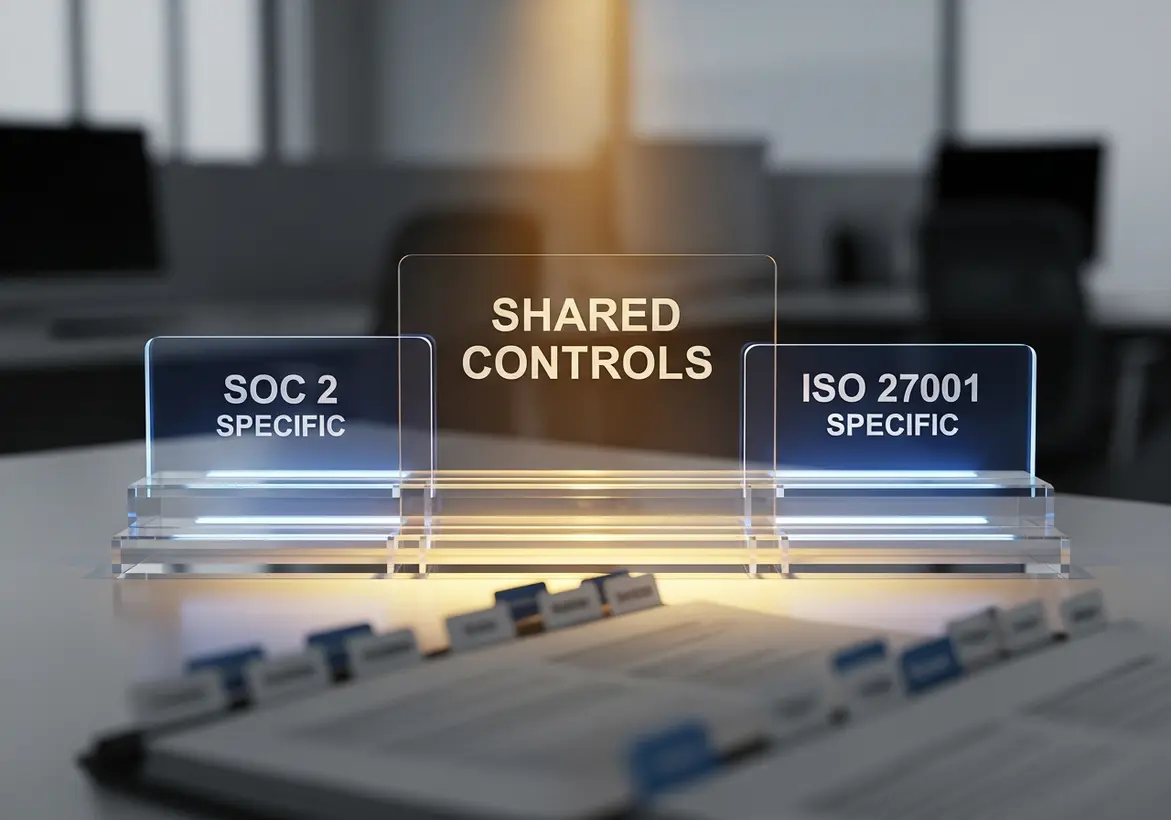
The remarkable opportunity in dual certification lies in recognizing that SOC 2 and ISO 27001 cover approximately 70-80% of the same security territory. Both frameworks require access controls, encryption, incident response procedures, vendor management, and regular security assessments. Both demand documentation, evidence collection, and third-party validation. The control overlap means you're building one comprehensive program that satisfies both frameworks simultaneously.
Pro tip: Map your controls against both frameworks during gap analysis rather than treating them as separate assessments - create a single control matrix showing which ISO 27001 controls map to which SOC 2 categories to prevent duplicate work and identify gaps that'll serve both frameworks.
Quickly Technologies, a 12-person seed-stage Canadian fintech platform, achieved both ISO 27001 and SOC 2 Type 2 certifications in 7 months through strategic parallel implementation, enabling enterprise payment processing contracts that were previously blocked by security requirements. Their success came from treating dual certification as a single integrated program rather than two separate initiatives.
Sequencing your dual certification timeline 🚀
The most efficient roadmap sequences certification priorities based on market urgency while leveraging control overlap. Canadian startups should typically begin with SOC 2 Type I to establish immediate credibility with enterprise prospects, then build toward SOC 2 Type II observation period while simultaneously implementing the additional documentation and governance structures you'll need for ISO 27001.
By month three or four of your SOC 2 observation period, you'll launch ISO 27001 implementation. Because 70-80% of controls already exist from your SOC 2 work, ISO 27001 primarily requires you to formalize governance, create management policies, and establish continuous improvement documentation. The combined effort typically adds less time than you'd spend pursuing certifications sequentially.
This parallel approach also satisfies investor due diligence more comprehensively. Investors increasingly expect founders to demonstrate not just current control effectiveness through SOC 2, but also systematic, documented security governance through ISO 27001. The combination signals operational maturity and global ambition that resonates more strongly than either certification alone. Instead of seeing dual certification as competing priorities, view it as an integrated roadmap that builds a security architecture capable of supporting international expansion.
Book a free consultation 📞
Dual certification doesn't have to derail your development roadmap. Canadian startups pursuing enterprise customers in North America and Europe need both SOC 2 and ISO 27001 - but understanding how to sequence them strategically keeps your team focused while maximizing efficiency. Schedule a free consultation to assess your market composition and create a dual certification strategy tailored to your growth stage.
Oleg
Co-Founder @ EIM
Serving the startup community since 2024
20+ years in Enterprise
EIM Services has partnered with multiple Canadian and International startups to deliver scalable, cost-effective, and solid solutions. Our expertise spans pre-seed to Series A companies, delivering modern continuous certification and compliance solutions tailored for Startups in the cost-effective and shortest possible time. As well as bringing automated financial systems that reduce financial overhead by an average of 50% while ensuring investor-grade reporting at a fraction of the cost of an in-house team. We've helped startups save thousands through strategic financial positioning and compliance excellence.
