

Table of Contents
- 1. Understanding SOC 2 fundamentals for Canadian founders 🏢
- 2. Comparing SOC 2 and ISO 27001 investments ⚖️
- 3. Measuring the financial impact of SOC 2 certification 💰
- 4. Navigating SOC 1 versus SOC 2 requirements 🧭
- 5. Assessing the difficulty of achieving SOC 2 readiness 📈
- 6. Implementing a realistic SOC 2 compliance checklist 📋
- 7. Securing enterprise contracts through verified compliance 🤝
- 8. FAQs ❓
- 9. Book a free consultation 📞
For Canadian tech founders, navigating complex enterprise procurement cycles presents a distinct challenge. Startups routinely lose six-figure enterprise contracts when procurement teams demand verified security postures that early-stage companies cannot immediately provide. SOC 2 certification provides a rigorous audit framework that proves your operational security, availability, and privacy controls meet strict enterprise expectations. This verified compliance accelerates sales cycles, satisfies investor due diligence, and transforms security from a perceived operational hurdle into a distinct competitive advantage. This article walks you through the fundamentals of SOC 2, the tangible return on investment for startups, and how to position your company for sustainable market growth.

Understanding SOC 2 fundamentals for Canadian founders 🏢
The AICPA SOC 2 framework establishes criteria for managing customer data based on five trust service principles: security, availability, processing integrity, confidentiality, and privacy. SOC 2 certification is not a surface-level compliance checklist. It's a comprehensive evaluation of how your internal systems operate, protect sensitive information, and sustain business continuity. You will establish detailed governance policies, implement robust technical controls, and document continuous evidence that auditors require to issue their formal attestation. This foundational framework requires organizations to prove that their systems are protected against unauthorized access and operational disruption.
For Canadian startups targeting North American markets, understanding what SOC 2 Type 2 is becomes essential for sustainable growth. While a Type 1 report captures your system's design at a single point in time, a Type 2 report observes your operational effectiveness over a sustained period. "Security is not a product, but a process." - Bruce Schneier. This principle defines effective compliance implementation, as the framework requires continuous monitoring rather than seasonal preparation. Establishing this operational rhythm early prevents scrambling when an enterprise client inevitably requests your security documentation.
Comparing SOC 2 and ISO 27001 investments ⚖️
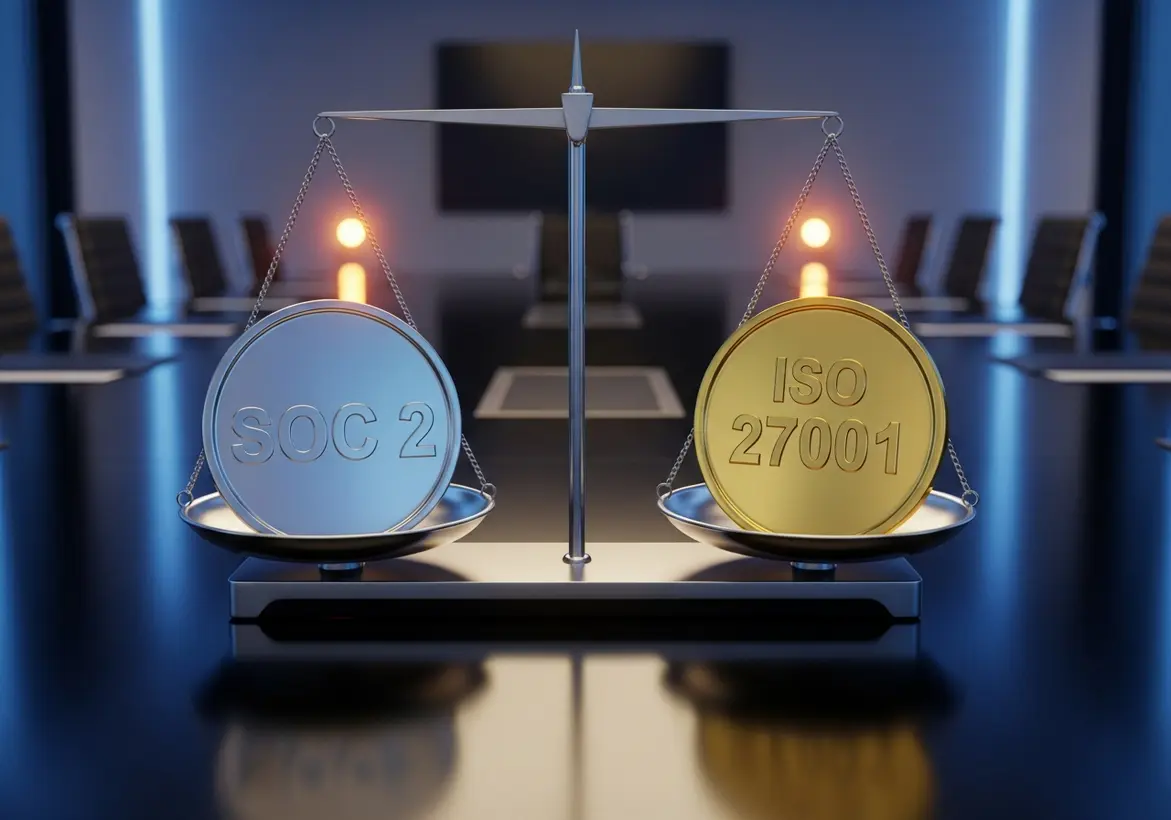
Is SOC 2 the same as ISO 27001? While both frameworks address information security, they serve different primary markets and follow distinct structural approaches. ISO 27001 provides an international specification for building an Information Security Management System, heavily recognized in European and global markets. Conversely, SOC 2 serves as the dominant standard for North American enterprise procurement, functioning as a detailed audit report rather than a management system certification. Understanding this geographic and structural distinction helps founders allocate their compliance budgets effectively based on their target demographics.
Smart founders recognize the substantial structural overlap between these distinct standards. Implementing controls for one framework satisfies approximately eighty percent of the foundational requirements for the other. Pro tip: Run SOC 2 and ISO 27001 in parallel if targeting international markets - framework overlap means minimal duplicate work when properly coordinated. Instead of seeing dual certification as an overwhelming compliance hurdle, see it as a consolidated strategic initiative that opens both North American and global enterprise markets simultaneously.
Measuring the financial impact of SOC 2 certification 💰
Measuring SOC 2 cost and return requires analyzing both the required implementation investment and the newly unlocked revenue potential. Founders who build security practices, maintain compliance documentation, and demonstrate continuous improvement position themselves for enterprise contracts that previously remained inaccessible. The initial investment encompasses control implementation, software tool subscriptions, and the final independent auditor fees. These financial commitments directly correlate to the complexity of your technology stack, the number of employees, and the specific trust services criteria you choose to evaluate.
The tangible return on investment typically materializes through significantly accelerated sales cycles and eliminated procurement bottlenecks. When enterprise procurement teams receive a clean SOC 2 Type 2 report, vendor security questionnaires shrink from hundreds of custom questions to a simple review of your auditor's attestation. This streamlined process reduces friction, empowers your sales team to close larger deals faster, and clearly demonstrates operational maturity during investor due diligence rounds. The resource savings from avoiding manual security reviews quickly offset the initial audit investments.
Quickly Technologies provides a clear demonstration of this measurable business impact. The twelve-person seed-stage platform handles sensitive payment processing and financial data. Through strategic parallel implementation, they achieved ISO 27001 and SOC 2 with EIM Services in seven months. This achievement enabled enterprise payment processing contracts previously blocked by security requirements, proving their compliance posture publicly through their trust center.
Navigating SOC 1 versus SOC 2 requirements 🧭
Understanding the difference between a SOC 1 and SOC 2 report ensures you pursue the correct attestation for your specific business model. SOC 1 focuses strictly on internal controls over financial reporting, primarily impacting startups that process financial transactions directly affecting their clients' financial statements. These rigorous audits ensure that a service organization's financial calculations, payroll processing algorithms, or automated billing systems operate with absolute precision and proper oversight. If your software calculates numbers that appear on another company's balance sheet, procurement teams will inevitably request a SOC 1 report.
SOC 2 expands the audit scope significantly to cover broader information security and operational risks. Rather than focusing on financial reporting, this framework evaluates how your organization handles sensitive customer data against the defined trust services criteria. For software-as-a-service companies, cloud infrastructure providers, and managed service providers, SOC 2 represents the mandatory baseline for demonstrating operational security to prospective clients. SOC 2 is not just an IT requirement. It's an organizational governance framework that touches every department.
The integration of modern technologies introduces new complexities to these frameworks, particularly concerning SOC 2 AI requirements. Companies deploying artificial intelligence must carefully document how they govern model training data, manage algorithmic bias, and protect client inputs from unauthorized exposure. Instead of treating these advanced controls as administrative burdens, treat them as vital governance structures that differentiate your product in an increasingly skeptical enterprise market.
Assessing the difficulty of achieving SOC 2 readiness 📈
Is it hard to get SOC 2 certified? The difficulty scales directly with your current operational maturity and existing technical debt. A startup operating without structured access controls, formalized incident response plans, or documented employee onboarding processes will face a steeper climb than one with foundational security practices already in place. The true challenge lies not in the technical implementation of security software, but in establishing a pervasive company culture of continuous evidence collection. Consistency proves more challenging than initial configuration.
Successful readiness requires systematic gap analysis followed by highly disciplined execution. You must identify missing security policies, implement necessary technical safeguards, and train your team to operate within the newly established boundaries. Pro tip: Use automated evidence collection tools for SOC 2 - manual screenshot gathering consumes significant preparation time that could be spent on strategic implementation. The founders who approach this readiness phase methodically build operational habits that scale effortlessly as the company grows.
Implementing a realistic SOC 2 compliance checklist 📋
A structured SOC 2 compliance checklist transforms overwhelming technical requirements into manageable implementation phases. The first step involves precisely defining your audit scope, determining exactly which systems, software products, and physical locations will undergo evaluation. You select the trust service criteria relevant to your business commitments, knowing that only the core security criterion remains universally mandatory for every organization pursuing this specific attestation. Proper scoping prevents wasted effort on systems that fall outside your primary customer data flows.
The next phase centers on conducting a thorough gap assessment against the selected criteria requirements. This comprehensive review highlights where your current access controls, vendor management procedures, and disaster recovery plans fall short of strict auditor expectations. Remediation follows immediately, during which your team writes missing governance policies, configures system logging protocols, and deploys encryption mechanisms to close identified vulnerabilities. This phase demands coordination between engineering, human resources, and executive leadership to ensure comprehensive coverage.
Ultimarii demonstrated the effectiveness of this structured approach by achieving SOC 2 Type 2 at month nine of their journey. By establishing a strong foundational posture, they seamlessly achieved three certifications with EIM Services and displayed their progress transparently via their trust site during sales conversations. The founder who approaches security controls with systematic documentation does more than satisfy auditors. They build operational resilience that scales predictably.
Securing enterprise contracts through verified compliance 🤝
The ultimate value of certification extends far beyond obtaining the final independent audit report. Attaining this level of verified compliance fundamentally shifts the power dynamic during high-stakes enterprise sales negotiations. When corporate buyers recognize that an independent auditor has thoroughly examined and validated your security infrastructure, technical objections quickly disappear from the procurement conversation. This verifiable trust accelerates deal velocity, reduces customer acquisition costs, and positions your startup alongside established industry leaders.
SOC 2 readiness is not about passing an audit. It's about demonstrating control maturity that investors and enterprise clients recognize as a leading indicator of sustainable success. Your organization shifts from reactive security posturing to proactive institutional governance. "It takes twenty years to build a reputation and five minutes to ruin it." - Warren Buffett. This reality underscores the importance of verified data protection. Instead of seeing compliance frameworks as necessary overhead expenses, see them as direct revenue enablers that clear the path for market expansion and lasting commercial partnerships.
FAQs ❓
What is the correct SOC 2 pronunciation?
The framework is universally pronounced as "sock two" in professional business environments. It refers to the System and Organization Controls reporting framework developed by the American Institute of Certified Public Accountants for thoroughly evaluating an organization's information security practices and data management protocols.
What is the SOC 2 full form?
The full form stands for System and Organization Controls 2. Originally derived from Service Organization Controls, the AICPA updated the terminology to better reflect its broad application to evaluating an organization's internal information systems, security policies, and comprehensive data privacy frameworks.
What does a SOC 2 Type 2 report mean?
A Type 2 report validates that your security controls are not just designed correctly, but operate effectively over a sustained observation period, typically spanning three to twelve months. This continuous evidence provides enterprise clients with maximum assurance regarding your startup's operational resilience.
How much does SOC 2 cost for a startup?
Certification costs vary based on company size, control complexity, and independent audit body selection. Book a free consultation to discuss pricing tailored to your specific situation and to map out a realistic financial roadmap for your compliance journey.
What evidence do I need for a SOC 2 audit?
You must provide documented policies, system configurations, access logs, employee onboarding records, and incident response documentation. Auditors require concrete proof that the security mechanisms you claim to have implemented function consistently and accurately throughout the entire designated review period.
Is it hard to get SOC 2 certified?
The difficulty depends entirely on your existing security posture. Companies starting from scratch face a heavier documentation burden than those with established processes. Following a structured implementation roadmap and leveraging automation significantly reduces the friction typically associated with the certification journey.
Book a free consultation 📞
Navigating enterprise procurement requires a verified compliance posture that proves your startup's operational maturity and robust data protection capabilities. EIM Services guides Canadian tech startups through structured certification journeys, transforming complex audit requirements into streamlined, scalable business advantages that accelerate revenue. Our systematic approach minimizes founder friction while maximizing operational resilience. Book a free consultation to evaluate your current security infrastructure, develop a customized readiness roadmap, and position your organization to close larger enterprise deals confidently.
Oleg
Co-Founder @ EIM
Serving the startup community since 2024
20+ years in Enterprise
EIM Services has partnered with multiple Canadian and International startups to deliver scalable, cost-effective, and solid solutions. Our expertise spans pre-seed to Series A companies, delivering modern continuous certification and compliance solutions tailored for Startups in the cost-effective and shortest possible time. As well as bringing automated financial systems that reduce financial overhead by an average of 50% while ensuring investor-grade reporting at a fraction of the cost of an in-house team. We've helped startups save thousands through strategic financial positioning and compliance excellence.
