

Table of Contents
- 1. Understanding the SOC 2 framework 🔍
- 2. Decoding Trust Services Criteria 📑
- 3. Distinguishing between SOC 1 and SOC 2 audits ⚖️
- 4. Comparing SOC 2 attestation to ISO 27001 🌍
- 5. Translating North American privacy requirements 🍁
- 6. Defining subservice organizations 🏗️
- 7. Understanding attestation timelines ⏳
- 8. FAQs ❓
- 9. Book a free consultation 📞
Enterprise buyers and regulators increasingly demand formalized proof of security before signing contracts. A SOC 2 attestation provides an independent examination of your organization's security posture, resulting in a formal report issued by a licensed CPA firm. This validation transforms your internal security practices into a verifiable asset, accelerating procurement cycles and positioning your startup as a trustworthy vendor. This article explains how the framework operates, what the specific criteria entail, how it compares to international standards, and how to prepare for your first formal audit.

Understanding the SOC 2 framework 🔍
A SOC 2 attestation is not just a static security badge. It is a detailed evaluation of your operational reality over time. The framework assesses your environment through two primary lenses that prove your control maturity to enterprise buyers.
A Type 1 report evaluates the design of your security controls at a specific point in time, proving you have the right policies and technical measures established. A Type 2 report tests the operating effectiveness of those controls over a continuous observation period, proving your team consistently follows your own documented rules. Most startups pursue a Type 1 report first to close immediate deals, using that baseline to mature their practices before entering their Type 2 observation window.
You establish access policies, implement continuous monitoring tools, and document the daily evidence that auditors require. This approach ensures your internal security practices align seamlessly with external reporting requirements.
Decoding Trust Services Criteria 📑
When you engage an auditing firm for your SOC 2 attestation journey, they evaluate your operations against highly specific reporting standards. Understanding this terminology prevents scope creep and clarifies exactly what evidence you must produce during the examination period to satisfy external reviewers. In the US, the examination is performed under the AICPA's attestation standards (AT-C 205, as revised by SSAE 21 in 2022); in Canada, CPA firms can report on the same criteria under CSAE 3000.
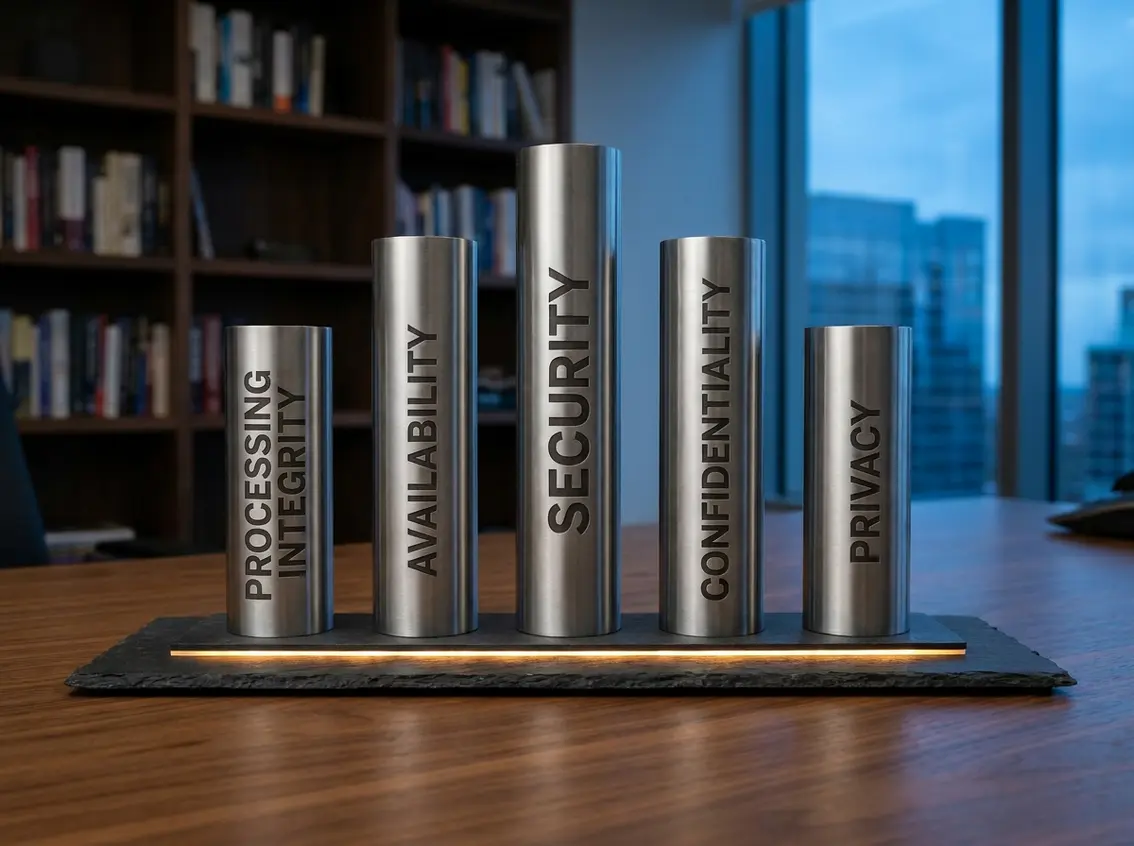
The actual technical controls are evaluated across five distinct Trust Services Categories: Security, Availability, Processing Integrity, Confidentiality, and Privacy. Auditors measure these categories using the 2017 Trust Services Criteria with 2022 Revised Points of Focus (AICPA & CIMA, 2023). This baseline defines exactly how reviewers assess your system boundaries, logical access controls, and operational health through screenshots, system configurations, and policy acknowledgments.
Pro tip: Do not attempt to tackle all five categories simultaneously during your first examination; most startups begin exclusively with the Security category to satisfy initial enterprise procurement requirements while minimizing implementation complexity.
Distinguishing between SOC 1 and SOC 2 audits ⚖️
Founders often confuse different reporting frameworks when enterprise buyers ask for compliance documentation. A SOC 1 examination evaluates internal controls over financial reporting, demonstrating that your service does not adversely affect your client's financial statements.
This financial evaluation targets payroll providers, billing systems, and institutions that handle monetary transactions daily. Unless your software directly processes payroll calculations or manages client general ledgers, enterprise procurement teams will typically reject a SOC 1 report as insufficient for vendor security screening. A SOC 2 attestation, by contrast, focuses entirely on information security and data handling practices. It evaluates how you protect customer data against unauthorized access, operational failures, and external threats over a continuous observation period.
Clarifying this distinction early prevents your engineering team from building controls for the wrong examination. You allocate resources efficiently, focus on the right technical measures, and generate the exact security evidence your buyers require.
Comparing SOC 2 attestation to ISO 27001 🌍
An attestation report is an examination specific to North American reporting rules under the AICPA, whereas ISO 27001 certification operates as the internationally recognized standard for information security management. Startups targeting cross-border markets often need both frameworks to satisfy diverse procurement teams globally.
Quickly Technologies, a seed-stage fintech platform for payment processing and financial operations, demonstrated this strategic alignment. They ran ISO 27001 and SOC 2 Type 2 in parallel; about 90% of controls were shared in our control mapping during their ISO 27001 and SOC 2 readiness led by EIM. Achieving ISO 27001 at month 4 let them pursue contracts requiring information security certification.
Their public trust center let sales conversations continue while the certification work was still underway.
Translating North American privacy requirements 🍁
Founders must understand how North American privacy laws map to audit controls before initiating an examination. In the United States, startups navigate a widening state-law patchwork led by California's CCPA/CPRA, which applies only to businesses above its specific revenue or consumer-data thresholds. However, enterprise buyers routinely enforce stringent contractual data-protection terms regardless of your startup's size.
In Canada, the regulatory baseline is federally anchored. PIPEDA covers private-sector commercial activity except where provincial laws like Alberta PIPA, BC PIPA, or Quebec Law 25 apply. Under this framework, PIPEDA mandates adherence to fair information principles regarding the collection and use of personal data (Office of the Privacy Commissioner of Canada, 2024).
The same work of turning legal duties into technical access limits applies to GDPR compliance if you serve EU customers, and to North American privacy readiness. By mapping privacy controls intelligently to the Privacy Trust Services Criteria, you build customer trust while meeting essential legal obligations across borders.
Defining subservice organizations 🏗️
No startup operates in a vacuum. Your infrastructure likely relies on cloud hosting providers, payment gateways, and specialized software vendors, creating complex system boundaries that auditors must carefully evaluate. Establishing these exact parameters properly is a fundamental part of the examination process.
Your report must say how each subservice organization is handled: the inclusive method brings the vendor's controls into your examination, while the carve-out method excludes them and relies on the vendor's own report (AICPA & CIMA, SOC 2 Report Walkthrough). This process involves reviewing your vendors' own attestation reports annually and mapping their complementary user entity controls to your internal security policies systematically.
Pro tip: Use the carve-out method (which excludes the vendor's controls from your own testing) for major cloud providers like AWS or Azure during your SOC 2 attestation preparation, as it allows you to rely on their attestations rather than attempting to test physical security controls yourself.

Understanding attestation timelines ⏳
Founders frequently underestimate how long a first attestation takes. Readiness comes first: policies, access controls, and a routine for collecting evidence. A Type 1 report can follow once your controls are designed and in place. A Type 2 report needs an observation period on top, because the auditor tests whether those controls kept operating over time. Quickly Technologies, running ISO 27001 alongside, received its SOC 2 Type 2 report at month 7.
The pressure comes from buyers. In a 2023 Gartner survey, 45% of organizations reported third-party-related business interruptions over the previous two years (Gartner, 2023). Buyers will not take your word on security; they require independent validation through structured examinations before integrating your software into their environments.
Plan the sequence backwards from your largest pending deal. If the buyer will accept a Type 1 report, that is your first milestone. If they require a Type 2, the observation period sets the earliest date you can deliver it, so start it as soon as your controls are in place.
FAQs ❓
What is the SOC 2 framework and what does it assess?
SOC 2 is a reporting framework developed by the AICPA that evaluates a service organization's internal controls. It assesses how effectively a company manages customer data based on five Trust Services Categories: Security, Availability, Processing Integrity, Confidentiality, and Privacy.
How long does it take to complete a SOC 2 examination?
It depends on your starting point and the report type. A Type 1 report can be issued once your controls are designed and in place; a Type 2 report also needs an observation period before the auditor can issue it. Quickly Technologies, running ISO 27001 in parallel, received its SOC 2 Type 2 report at month 7. Book a free consultation for a customized roadmap tailored to your specific operational situation.
Is a SOC 2 attestation the same as ISO 27001?
No. ISO 27001 is an internationally recognized certification providing a systematic framework for an Information Security Management System. The AICPA's framework results in an attestation report primarily recognized in North America that proves specific controls were designed or operating effectively.
What is the difference between a SOC 1 and SOC 2 audit?
A SOC 1 examination evaluates controls relevant to a user entity's internal control over financial reporting, necessary for payroll or billing systems. A SOC 2 examination evaluates controls relevant to information security, availability, and data protection, which enterprise buyers typically request from SaaS vendors.
How does Canadian privacy law impact SOC 2 readiness?
Canadian startups must align their Privacy Trust Services Criteria with statutory obligations. PIPEDA and provincial laws like Quebec Law 25 require organizations to implement specific safeguards, consent mechanisms, and accountability structures that auditors will test if the Privacy category is in scope.
Book a free consultation 📞
Navigating a SOC 2 attestation requires a clear roadmap tailored to your startup's current security posture, architecture, and growth stage. EIM Services has guided seed-stage and Series A companies through structured readiness journeys that satisfy stringent enterprise procurement demands without disrupting daily product development. Book a free consultation to discuss your compliance readiness, build a realistic implementation plan, and understand exactly what these reporting frameworks mean for your specific business goals.
Oleg
Co-Founder @ EIM
Serving the startup community since 2024
20+ years in Enterprise
EIM Services has partnered with multiple Canadian and International startups to deliver scalable, cost-effective, and solid solutions. Our expertise spans pre-seed to Series A companies, delivering modern continuous certification and compliance solutions tailored for Startups in the cost-effective and shortest possible time. As well as bringing automated financial systems that reduce financial overhead by an average of 50% while ensuring investor-grade reporting at a fraction of the cost of an in-house team. We've helped startups save thousands through strategic financial positioning and compliance excellence.
