

Table of Contents
- 1. Understanding Series A venture funding expectations 📈
- 2. How compliance standards align with institutional capital 🏦
- 3. Why Series A investors require SOC 2 and ISO 27001 readiness 🛡️
- 4. Implementing AI governance with ISO 42001 for venture deals 🤖
- 5. Navigating privacy laws across Canadian and US markets ⚖️
- 6. Building a multi-framework certification roadmap 🗺️
- 7. Positioning your startup for the next funding tier 🎯
- 8. FAQs ❓
- 9. Book a free consultation 📞
Startup founders targeting their first major institutional capital raise face intense scrutiny over operational maturity and data protection. Aligning your compliance roadmap with your funding timeline transforms security from a rushed afterthought into a verifiable asset that accelerates due diligence. This strategic alignment helps you build investor confidence, unlock enterprise procurement conversations, and secure larger capital allocations by proving you can protect customer data at scale. This article walks you through matching specific frameworks like SOC 2, ISO 27001, and privacy regulations to your Series A preparation strategy.

Understanding Series A venture funding expectations 📈
For tech founders, a Series A marks the critical transition from seed-stage experimentation to institutional venture capital backing. At this juncture, the expectations placed on your business transform dramatically. You are no longer just proving that your product works; you demonstrate that your entire organization scales securely without exposing investors to systemic risk.
Founders often ask what a Series A vs. Series B is when planning their long-term growth trajectory. The distinction fundamentally comes down to scale, operational maturity, and proven product-market fit. While earlier rounds fund initial development, a series A provides the capital to scale sales operations, and a series B focuses on massive market expansion. Investors at this pivotal scaling stage demand rigorous documentation, meaning your security posture evolves from informal internal practices into verifiable, enterprise-grade governance systems that satisfy independent auditors.
How compliance standards align with institutional capital 🏦
Achieving recognized compliance is not just about passing a technical audit. It is about demonstrating control maturity that institutional investors recognize as a prerequisite for deploying significant capital. As startups prepare to raise their next funding round, they transition away from ad-hoc security measures in favor of continuous, evidence-based management frameworks. This shift proves to the market that your executive team understands the operational realities of handling enterprise data.
For example, AICPA (2026) publishes the attestation standards, including AT-C Section 205 for examination engagements, that a CPA firm follows when it performs a SOC 2 examination. A Type 2 report tests whether your controls operated over an observation period rather than at a single moment in time. You establish policies, implement technical safeguards, and document evidence that auditors require continuously. Enterprise buyers ask for this independent evidence in their security reviews, and investors check it during due diligence because a stalled security review can stall the revenue plan they are funding.
Pro tip: If an enterprise prospect asks for a SOC 2 report before your Type 2 observation period ends, a Type 1 report can cover the gap. Start gap analysis the moment you enter enterprise sales conversations rather than waiting for customer demands.
Why Series A investors require SOC 2 and ISO 27001 readiness 🛡️
(CVCA Intelligence, 2026) reports that in the first half of 2026, Canadian venture deals under $25M made up 85% of all disclosed deals but only 32% of the dollars invested, while 16 rounds of $50M or more took 59% of the capital. CVCA describes the pattern as fewer and larger financings. For a B2B SaaS or AI startup, the traction that earns a larger round usually runs through enterprise sales, and enterprise sales run through a security review.
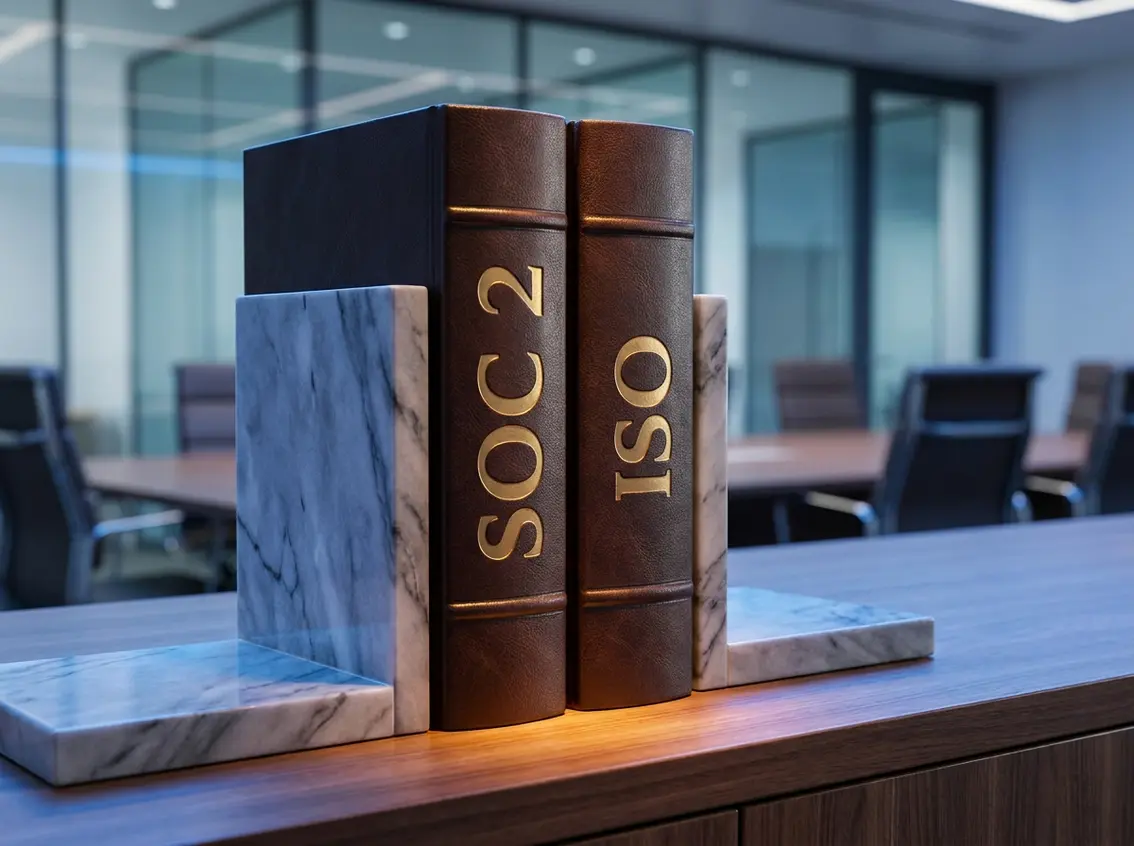
In North America, enterprise buyers typically require a SOC 2 attestation (an independent CPA report on your security controls) before they sign, and Series A investors check for it because it determines how fast those deals close. If you sell internationally, ISO 27001 certification (the global standard for information security management) is the more common requirement. Both frameworks signal to the market that your startup handles data with enterprise-level discipline, creating audit trails that satisfy rigorous procurement teams.
For instance, Quickly Technologies, then a 12-person seed-stage fintech, worked through an EIM-guided implementation to reach ISO 27001 certification at month four and a SOC 2 Type 2 attestation at month seven, showing its progress to prospects through a public trust center. Quickly ran both frameworks in parallel, with about 90% of controls shared in the control mapping, so ISO 27001 at month four let it pursue contracts requiring information security certification while the SOC 2 observation period was still running.
Implementing AI governance with ISO 42001 for venture deals 🤖
For artificial intelligence startups, SOC 2 and ISO 27001 cover information security but not the risks specific to AI systems. Enterprise buyers increasingly ask how you manage model errors, automated decision-making risks, and training data integrity, and investors look at whether you can answer them. This specialized scrutiny requires a dedicated governance framework that addresses the unique operational realities of artificial intelligence systems. Startups that cannot verify their algorithmic safeguards face severe friction when negotiating high-value procurement deals or closing venture rounds.
ISO 42001 establishes an internationally recognized management system specifically for artificial intelligence, providing a structured approach to mapping and mitigating these complex algorithmic risks. Implementing this standard transforms vague promises about ethical technology into a verifiable system of continuous governance. When EIM Services leads your ISO 42001 implementation, we ensure your risk management processes integrate seamlessly with your existing information security operations, reducing friction across your engineering teams.
Ultimarii, an AI company where EIM led the ISO 42001 implementation, started that work in month seven of its compliance program and was certified at month eleven, with the certificate issued in August 2025, placing it among the first 50 companies certified globally. Its existing ISO 27001 and SOC 2 controls already covered about 30% of ISO 42001's controls. The ISO 42001 case study shows how the work was sequenced.
Navigating privacy laws across Canadian and US markets ⚖️
North American privacy compliance requires addressing both Canadian and United States jurisdictions comprehensively. In Canada, federal mandates like PIPEDA and provincial rules like Quebec Law 25 dictate strict data handling protocols for consumer and employee information. South of the border, the United States relies on a widening state-law patchwork led by California regulations like the CCPA, alongside the contractual data-protection terms that enterprise buyers attach to every procurement. You cannot present a localized compliance strategy when investors expect global scalability.
Federal privacy reform is still pending. According to the Parliament of Canada (LEGISinfo, 2026), Bill C-36, the proposed Protecting Privacy and Consumer Data Act, received first reading on June 15, 2026, and is at second reading in the House of Commons, so PIPEDA remains the federal law in force. C-36 follows Bill C-27, which died when Parliament was prorogued in January 2025, taking the proposed Artificial Intelligence and Data Act (AIDA) with it. Build today's privacy program on PIPEDA, Quebec Law 25 and the US state laws that apply to you, and track C-36 as it moves through Parliament.
Pro tip: Map where personal data flows (systems, vendors and countries) and update the map whenever you add a vendor. Diligence teams and enterprise privacy reviews commonly ask for it, and PIPEDA's accountability principle expects you to know what you hold.
Building a multi-framework certification roadmap 🗺️
Pursuing multiple standards simultaneously is often the most efficient path for scaling startups preparing for institutional investment. Many requirements across different frameworks overlap significantly, allowing you to design a single internal control that satisfies multiple external audits. This parallel strategy reduces overall preparation effort, minimizes resource drain, and prevents the operational disruption of sequential, never-ending compliance projects that distract your engineering teams from core product development.
A SOC 2 Type 2 report can only be issued after an observation period, commonly three months for a first report, and ISO 27001 certification requires a two-stage audit by an accredited certification body. To prevent deal delays during fundraising, founders initiate readiness preparations well before they plan to open their next funding round, ensuring audit reports are finalized before due diligence begins.
Consider how Ultimarii approached this challenge through their EIM-guided compliance implementation. They achieved ISO 27001 at month four and their SOC 2 Type 2 attestation at month nine, then added ISO 42001, certified at month eleven, showing its progress in real time on their trust site during sales conversations. With SOC 2 Type 2 in place, Ultimarii could pursue Fortune 500 and government opportunities that require both ISO 27001 and SOC 2, while its CTO and EIM ran the implementation and the founders stayed on growth.

Positioning your startup for the next funding tier 🎯
The founder who approaches security controls with systematic documentation does more than satisfy auditors. They build operational resilience that scales effortlessly as the company expands. The first step is conducting a thorough gap analysis against your target frameworks to identify where your current practices diverge from standard requirements. The next is implementing the necessary policies, technical safeguards, and employee training programs. Finally, you transition into continuous monitoring to ensure those controls operate effectively over time.
Budget for two kinds of costs: the auditor's or certification body's fees, and the internal readiness work (policies, tooling, evidence collection, and staff time) that comes before the audit. Put both in the operating plan you share with investors, so the spend reads as part of your go-to-market plan rather than a surprise. By strategically matching your compliance milestones to your capital raise timeline, you transform an operational expense into a powerful financial asset. This proactive approach accelerates institutional investment, expedites enterprise procurement cycles, and secures your position as a trusted vendor in the competitive North American market.
FAQs ❓
What does a SOC 2 Type 2 examination measure?
A SOC 2 Type 2 report evaluates the operational effectiveness of your security controls over a continuous observation period, rather than a single point in time. This attestation provides institutional investors with independent verification that your startup maintains consistent data protection practices.
How long does the certification readiness process take?
Timelines depend on your existing control documentation, team availability, and technical infrastructure readiness. In EIM engagements, Quickly reached ISO 27001 at month four and SOC 2 Type 2 at month seven, and Ultimarii reached SOC 2 Type 2 at month nine. Book a free consultation to review your current state and develop a realistic implementation timeline tailored to your specific Series A fundraising schedule.
Is ISO 27001 necessary for Canadian startups?
While SOC 2 is widely recognized across North America, ISO 27001 is the international standard for information security management. Canadian startups targeting European or global enterprise markets often need ISO 27001 certification to shorten procurement security reviews and close cross-border deals.
How do privacy laws impact venture capital due diligence?
Investors assess whether your startup legally processes user data under frameworks like PIPEDA and the CCPA. Failing to maintain compliant data practices creates liability that diligence teams flag, and an unresolved privacy issue can delay a round or change its terms.
Can we implement ISO 42001 alongside other frameworks?
Yes. ISO 42001 shares significant structural overlap with ISO 27001. Startups can leverage their existing information security management systems to accelerate artificial intelligence governance implementation, reducing duplicate effort and demonstrating comprehensive technological maturity to potential venture capital partners.
What is the difference between an attestation and a certification?
A SOC 2 report is an attestation where a licensed CPA firm verifies that your specific security controls operate effectively. Conversely, ISO 27001 is a certification where an accredited body confirms your organization adheres to a globally standardized information security management system.
Book a free consultation 📞
Navigating complex compliance requirements for your Series A round demands a clear, strategic roadmap tailored to your startup's specific growth stage. EIM Services helps Canadian and US founders implement scalable security, privacy, and artificial intelligence governance frameworks that seamlessly satisfy rigorous venture capital due diligence. Book a free consultation to discuss your compliance readiness strategy, align your certification milestones with your target funding timeline, and position your startup to secure lucrative enterprise contracts with absolute confidence.
Oleg
Co-Founder @ EIM
Serving the startup community since 2024
20+ years in Enterprise
EIM Services has partnered with multiple Canadian and International startups to deliver scalable, cost-effective, and solid solutions. Our expertise spans pre-seed to Series A companies, delivering modern continuous certification and compliance solutions tailored for Startups in the most cost-effective and shortest possible time as well as bringing automated financial systems that reduce financial overhead by an average of 50% while ensuring investor-grade reporting at a fraction of the cost of an in-house team. We've helped startups save thousands through strategic financial positioning and compliance excellence.
