

Table of Contents
Enterprise procurement teams demand rigorous evidence of your security posture before signing contracts. The traditional security questionnaire method creates a massive bottleneck for growing startups, turning sales velocity into a tedious administrative exercise. A formal SOC 2 attestation replaces most of these endless spreadsheets with an independent, verified report that many procurement teams accept in place of a custom questionnaire, or alongside a much shorter one. For founders navigating both US and Canadian markets, this proactive approach removes most of the friction of vendor risk assessments. This article breaks down how attestation controls map to procurement surveys, how to build an automated trust center, and the practical steps to cut manual assessments down to the questions your report doesn't cover.

Understanding the security questionnaire method
The manual questionnaire method asks vendors to self-report on their security practices through hundreds of closed-ended and open-ended questions. Enterprise buyers rely on these surveys to assess third-party risk, particularly to meet privacy obligations such as PIPEDA in Canada or state privacy laws in the US. Many buyers start from a standardized set such as the Shared Assessments SIG or the Cloud Security Alliance's CAIQ and then add questions of their own. Every new prospect means another round of answers, and the work usually lands on the same few engineers.
The core difference between a self-reported survey and an independent attestation lies in validation. Questionnaires are point-in-time claims that require buyers to trust your unverified word. A SOC 2 Type 2 attestation provides third-party verification that your stated controls operated as described over an observation period. You'll transition from asking buyers to take your word for it, to handing them audited proof that addresses most of their requirements in one document.
Mapping SOC 2 controls to enterprise surveys
When you analyze standard procurement surveys side by side, the underlying requirements repeat themselves across different formats. SOC 2 examinations are built on the AICPA's 2017 Trust Services Criteria (with revised points of focus from 2022), which set control benchmarks across five categories: Security, Availability, Processing Integrity, Confidentiality, and Privacy, for engagements performed under SSAE No. 18 (AICPA & CIMA, 2023). Access control, change management, incident response, vendor management, and encryption appear in both the criteria and most questionnaires. That overlap is what makes a crosswalk possible.
As explored in EIM on Security Questionnaires vs Certifications: Faster Deals, having this attestation allows you to push back on manual data entry. You map your audited controls to their requirements using a crosswalk document. Many procurement teams accept a SOC 2 attestation because it provides the standardized assurance they need without the burden of reviewing a custom survey response.
Expect a short supplemental questionnaire even with a clean report. Buyers will still ask about anything outside your audit scope, such as how you use AI on customer data, sub-processors added since the report period, or contract-specific privacy terms. Answer those in writing and point every other question to the relevant section of your report. A useful crosswalk lists each questionnaire domain, the matching Trust Services Criteria, and the section of your report where the auditor tested that control.
Pro tip: Create a standardized cover letter that maps your SOC 2 Trust Services Criteria to the most common enterprise questionnaire domains, allowing you to politely decline custom spreadsheets while still answering their underlying risk queries.
Automating responses through verifiable trust centers ⚙️
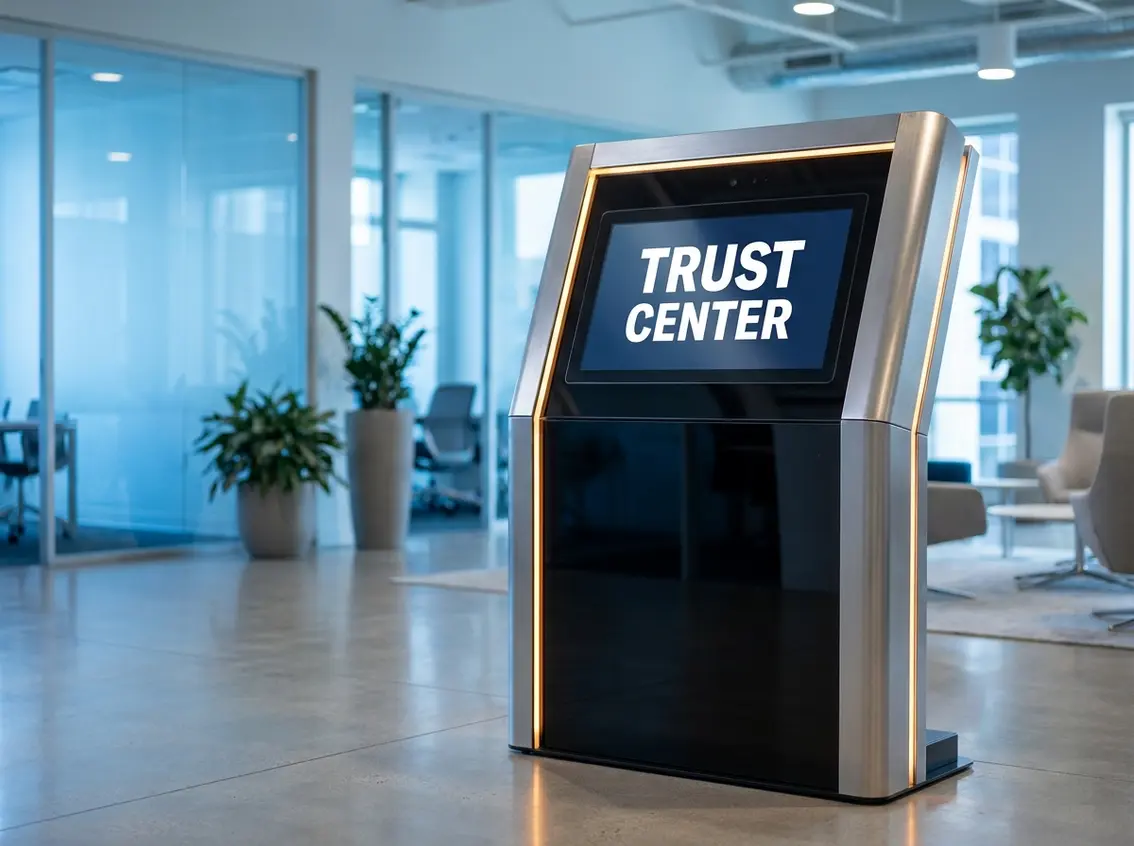
Storing your attestation report in an accessible trust center transforms how you handle inbound survey requests. Instead of routing spreadsheets through your engineering team, sales reps send a single link where prospects can execute a non-disclosure agreement and download your audited reports automatically. This self-serve model removes the internal friction that delays contract signatures while demonstrating a sophisticated security posture to buyers.
Quickly Technologies, a 12-person seed-stage fintech, achieved ISO 27001 at month 4 and SOC 2 Type 2 at month 7 through parallel implementation - unlocking enterprise payment contracts that previously required completed security validations. Their trust center made compliance verifiable to every enterprise prospect, cutting back on manual surveys. See how they did it: ISO 27001 and SOC 2 readiness led by EIM. Pro tip: Integrate your trust center's NDA execution directly into your CRM workflow so sales teams get notified the moment a prospect downloads your compliance package.
Transitioning from reactive surveys to proactive trust
Moving away from ad-hoc responses requires a structural shift in how your startup approaches vendor risk management. You'll establish policies, implement controls, and document evidence that auditors require to issue a formal report.
Plan for the gaps between reports. A Type 1 report assesses control design at a single point in time, while a Type 2 report tests whether those controls operated over an observation period, commonly three to twelve months. Many buyers accept a Type 1 while your first Type 2 observation period runs; larger enterprises usually expect the Type 2. Between annual reports, a bridge letter covers the gap: a short statement signed by your management stating whether any material changes to your controls have occurred since the report period ended. Because management signs it rather than the auditor, keep it accurate and keep it short.
This transition frees your technical talent from administrative purgatory while elevating your brand perception. Buyers interpret independent attestation as a signal of operational maturity that outshines competitors who are still filling out spreadsheets. This foundation also makes future frameworks easier to adopt, as you already possess a structured evidence collection process.
A SOC 2 attestation isn't just about checking boxes to appease procurement. It's about building security into your operational DNA. Instead of seeing enterprise surveys as an administrative burden, see the attestation process as a competitive differentiator that accelerates sales cycles.
FAQs ❓
Can a SOC 2 report fully replace a security questionnaire?
Usually not entirely. Many buyers accept the report in place of the bulk of their questionnaire, then send a short supplemental set covering anything outside your audit scope, such as AI use or contract-specific privacy terms.
Will buyers accept a SOC 2 Type 1 report?
Often, as an interim step. A Type 1 shows your controls are suitably designed and in place at one point in time, and many buyers accept it while your Type 2 observation period runs. Larger enterprises generally expect a Type 2 at renewal.
What is a bridge letter?
A bridge letter is a short statement signed by your management that covers the time between the end of your last SOC 2 report period and today, stating whether any material changes to your controls have occurred. It is not audited, so buyers treat it as a supplement to the report, not a substitute.
How long does SOC 2 readiness take, and what does it cost?
Timelines depend on your starting point and the observation period you choose. In an EIM-led engagement, a 12-person fintech reached SOC 2 Type 2 in month 7 while running ISO 27001 in parallel. Costs break down into readiness work, the CPA firm's audit fee, and your team's time. Book a free consultation to get a roadmap and budget for your stage.
Book a free consultation
Manual security questionnaires shouldn't bottleneck your startup's enterprise sales cycle or drain your engineering resources. EIM Services helps startup founders build SOC 2 control programs that satisfy complex enterprise procurement requirements while maintaining your team's product development velocity. Book a free consultation to discuss your current security posture and get a customized attestation roadmap for your specific stage. Stop answering the same compliance questions repeatedly and start closing major enterprise deals with proactive, verified trust.
Oleg
Co-Founder @ EIM
Serving the startup community since 2024
20+ years in Enterprise
EIM Services has partnered with multiple Canadian and International startups to deliver scalable, cost-effective, and solid solutions. Our expertise spans pre-seed to Series A companies, delivering modern continuous certification and compliance solutions tailored for Startups in the most cost-effective and shortest possible time. As well as bringing automated financial systems that reduce financial overhead by an average of 50% while ensuring investor-grade reporting at a fraction of the cost of an in-house team. We've helped startups save thousands through strategic financial positioning and compliance excellence.
