

Table of Contents
- 1. Understanding ISO 42001 fundamentals 🧠
- 2. How ISO 42001 differs from ISO 27001 ⚖️
- 3. Why startups need AI governance before scaling 📈
- 4. Building your AI management system step by step 🏗️
- 5. Navigating the relationship between ISO 23894 and ISO 42001 🔗
- 6. Preparing for certification readiness effectively 🎯
- 7. Positioning your startup for enterprise AI deals 💼
- 8. FAQs ❓
- 9. Book a free consultation 📞
Enterprise buyers and government procurement teams increasingly demand proof that your artificial intelligence models are ethical, transparent, and rigorously governed. ISO 42001 establishes an internationally recognized framework that transforms abstract AI promises into verifiable, systematic governance structures. This standardization gives founders a distinct competitive advantage, enabling them to bypass lengthy procurement roadblocks and secure significant enterprise contracts with confidence. This article walks you through the fundamentals of AI management systems, how they differ from traditional security standards, and how to position your startup for enterprise scale without slowing down engineering momentum.
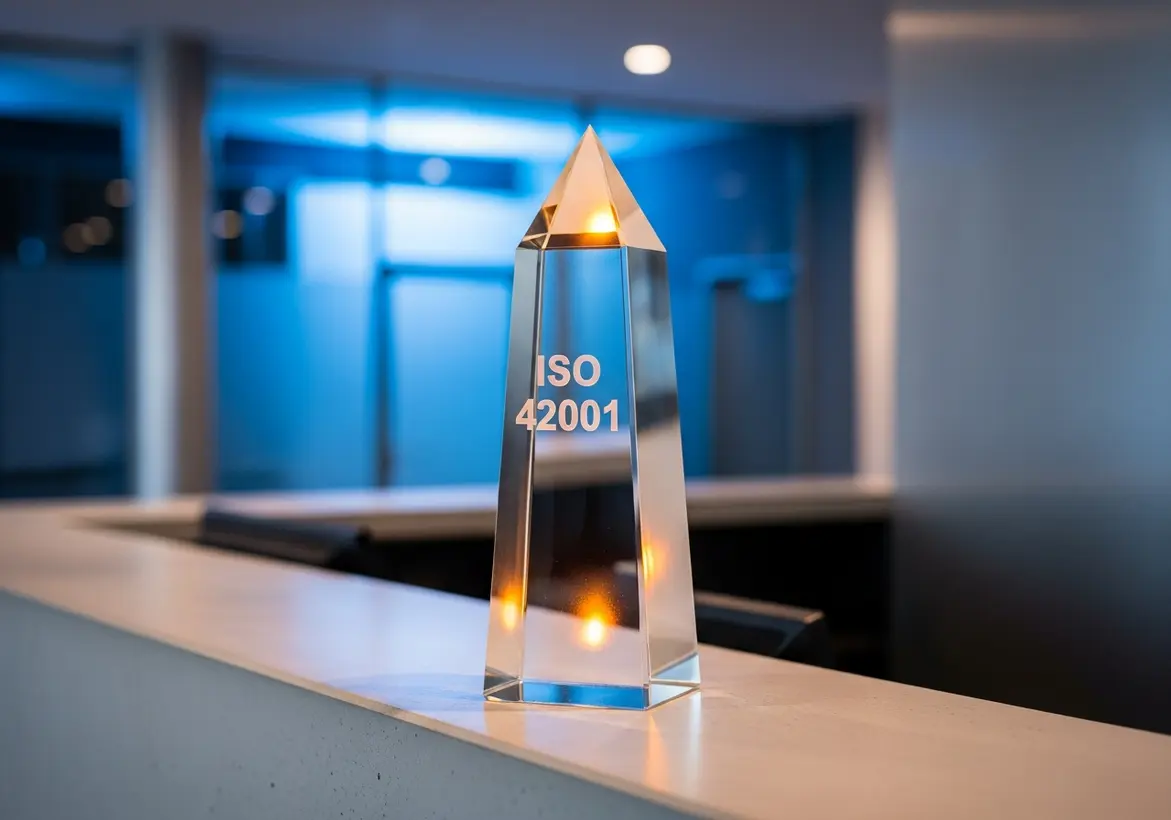
Understanding ISO 42001 fundamentals 🧠
ISO 42001 establishes a comprehensive international standard that defines exact requirements for building, implementing, and continually improving an Artificial Intelligence Management System. The framework requires companies to look beyond basic software development and apply systematic governance to how machine learning models are trained, deployed, and monitored. You'll establish policies, implement specific controls, and document evidence that auditors require to verify responsible AI practices.
The core of this system revolves around continuous risk management and ethical alignment throughout the product lifecycle. Founders define clear organizational roles for AI oversight, assess algorithmic bias, and maintain transparent documentation regarding how their models make decisions. This framework reduces regulatory risk, streamlines development operations, and creates audit trails that satisfy enterprise procurement teams. Instead of seeing AI governance as an innovation bottleneck, see it as a structural foundation that ensures your technology scales safely and predictably across international markets.
How ISO 42001 differs from ISO 27001 ⚖️
ISO 42001 isn't a replacement for traditional information security protocols. It's a specialized governance layer designed specifically for the unique complexities of artificial intelligence. While achieving ISO 27001 certification focuses strictly on protecting data confidentiality, integrity, and availability, the AI management standard addresses issues like algorithmic transparency, automated decision-making fairness, and systemic bias. Founders often confuse the two, assuming that securing their database automatically means their machine learning models operate responsibly and compliantly.
The operational distinction becomes clear during the risk assessment phases. Security standards mitigate external threats and data breaches, whereas AI standards mitigate the risks generated by the product itself, such as hallucination or discriminatory outputs. Fortunately, these frameworks integrate seamlessly through a shared high-level structure that streamlines your compliance journey.
Pro tip: Run your gap analysis for both frameworks simultaneously if targeting international markets - framework overlap means minimal duplicate work when properly coordinated.
Why startups need AI governance before scaling 📈
Pre-seed and Series A founders face immense pressure to deploy features rapidly, often treating governance as a future milestone. Delaying structural oversight creates insurmountable technical debt and severely limits your total addressable market. Enterprise clients simply won't integrate untested AI into their workflows without independently verified proof of responsible development.
A certified management system fundamentally changes how your sales team approaches enterprise procurement conversations. When buyers ask complex questions about hallucination risks, data accuracy, or ethical oversight, you answer with internationally recognized credentials rather than subjective assurances. You'll build standardized risk assessments, maintain impact logs, and demonstrate continuous improvement that procurement departments require.
Enterprise buyers increasingly ask pointed questions about AI risk management, bias prevention, and data accuracy. Ultimarii answers those questions with internationally recognized credentials rather than internal claims - achieving ISO 42001 certification with EIM Services in 4 months, with everything verifiable through their trust site.
Building your AI management system step by step 🏗️
The first step involves defining the exact scope of your artificial intelligence operations and the specific boundaries of your management system. The standard requires documenting which models you develop internally, which third-party foundation models you leverage, and exactly how data flows through your infrastructure. This scoping exercise clarifies your regulatory responsibilities and ensures you don't waste resources governing external systems outside your control.
Begin by performing a rigorous risk assessment tailored to your specific application of machine learning. This involves identifying potential societal impacts, evaluating fairness metrics, and documenting mitigation strategies for every identified vulnerability. This systematic approach ensures that safety considerations become embedded into your engineering sprints rather than being treated as an afterthought during final testing.
"Security is not a product, but a process." - Bruce Schneier. This principle applies perfectly to AI governance implementation. The certification body ultimately evaluates whether your management system continuously monitors algorithm performance and actively corrects deviations. The founder who approaches AI controls with systematic documentation does more than satisfy auditors. They build operational resilience that scales predictably.

Navigating the relationship between ISO 23894 and ISO 42001 🔗
Understanding the nuanced differences between various artificial intelligence standards prevents significant strategic missteps and wasted resources during your compliance journey. ISO 23894 provides specific guidance entirely focused on risk management within AI systems, acting as a deep-dive manual for identifying and mitigating technical vulnerabilities. In contrast, ISO 42001 certification represents the overarching certifiable management system that encompasses risk, resource allocation, leadership responsibilities, and continuous operational improvement.
You can't officially certify your company against the 23894 risk management guidelines alone, as they're purely informational. Instead, you'll utilize those detailed guidelines as a supporting toolkit to satisfy the rigorous risk assessment requirements mandated by your broader certifiable management system. You'll leverage the specific risk categorization frameworks found within the supporting guidelines to build the precise risk treatment plans required by your primary certification auditors, ensuring comprehensive regulatory coverage across technical safeguards and overarching policies.
Preparing for certification readiness effectively 🎯
Certification readiness isn't about rushing to collect screenshots a week before an auditor arrives. It's about fundamentally aligning your daily engineering practices with international compliance expectations. Preparation begins with conducting a thorough gap analysis to identify exactly where your current product development lifecycle falls short of the standard's extensive control requirements.
The next phase focuses heavily on remediation and evidence generation across your entire technical stack. You'll draft AI-specific usage policies, implement automated fairness testing, and maintain detailed impact assessments for every significant algorithmic update. Auditors require several months of operational history to verify that your team consistently follows the documented procedures rather than just writing theoretical policies.
Strategic resource allocation proves vital during this intensive preparation period. Delegating implementation oversight to specialized partners allows your core technical team to remain focused on product development and revenue generation.
Pro tip: Use automated evidence collection tools - manual screenshot gathering consumes significant preparation time that could be spent on implementation and control refinement.
Positioning your startup for enterprise AI deals 💼
Achieving ISO 42001 certification fundamentally transforms your market positioning and accelerates sales velocity. As regulatory environments tighten globally, corporate legal teams block vendors that can't provide independent verification of their ethical guidelines and data handling practices. Presenting a formal certificate immediately bypasses these initial procurement hurdles and positions your startup as a mature, enterprise-ready partner capable of navigating complex vendor assessments.
This credential actively protects your valuation during intense investor due diligence rounds by proving you've structurally mitigated significant regulatory risks. You build investor confidence, streamline vendor onboarding, and create a verifiable trust perimeter around your proprietary technology. Maintaining this elite status requires ongoing commitment to internal audits and annual surveillance reviews by accredited bodies. Instead of treating AI compliance as a burdensome legal checkbox, treat it as a powerful customer trust framework that dramatically strengthens your competitive market position.

FAQs ❓
How does the ISO 42001 certification standard work?
This standard specifies the internationally recognized requirements for establishing, implementing, maintaining, and continually improving an Artificial Intelligence Management System within your organization. It provides a highly structured framework that helps organizations develop and deploy AI technologies responsibly, ethically, and securely while systematically managing associated operational risks across all global jurisdictions.
What distinguishes ISO 27001 from AI governance standards?
While traditional information security frameworks focus strictly on protecting data confidentiality, integrity, and availability against external threats, AI management systems specifically address the unique risks generated by the machine learning models themselves. This includes managing algorithmic bias, ensuring automated decision-making transparency, preventing harmful hallucinations, and governing ethical product development lifecycles from initial training data collection through to final production deployment.
How do ISO 23894 guidelines support formal certification?
The 23894 standard serves as a specialized, non-certifiable guidance document focused entirely on artificial intelligence risk management techniques and technical vulnerabilities. In contrast, the certifiable management system encompasses much broader organizational requirements, including resource allocation, leadership responsibilities, policy creation, and continuous operational improvement mechanisms that accredited external auditors formally validate.
What evidence do certification auditors look for during assessments?
Auditors require comprehensive documentation demonstrating systemic oversight across your entire artificial intelligence infrastructure. This includes formalized algorithmic risk assessments, documented ethical guidelines, AI system impact logs, internal audit results, and verifiable proof that your technical team consistently follows established governance procedures during their daily product development rather than just drafting theoretical policies.
How much does certification implementation and auditing cost?
Certification costs vary significantly based on your company size, the complexity of your machine learning models, your current governance posture, and your selected audit body. Book a free consultation to discuss pricing tailored to your specific situation and to map out a strategic implementation roadmap for your team.
Book a free consultation 📞
Enterprise customers demand rigorous, independent proof of ethical artificial intelligence governance before signing procurement contracts with emerging vendors. EIM Services partners directly with ambitious startup founders to design and implement robust AI management systems that pass complex vendor assessments and accelerate global market entry. Book a free consultation to discuss your current operational readiness, develop a strategic certification roadmap, and discover how verifiable compliance directly drives enterprise revenue growth without slowing down your engineering sprints.
Oleg
Co-Founder @ EIM
Serving the startup community since 2024
20+ years in Enterprise
EIM Services has partnered with multiple Canadian and International startups to deliver scalable, cost-effective, and solid solutions. Our expertise spans pre-seed to Series A companies, delivering modern continuous certification and compliance solutions tailored for Startups in the cost-effective and shortest possible time. As well as bringing automated financial systems that reduce financial overhead by an average of 50% while ensuring investor-grade reporting at a fraction of the cost of an in-house team. We've helped startups save thousands through strategic financial positioning and compliance excellence.
