

Table of Contents
- 1. Why the traditional SOC 2 playbook no longer applies 🔄
- 2. What it actually costs in 2026 — Type I and Type II 📊
- 3. Breaking down every cost component 🔍
- 4. The GRC-first approach: how automation changes the math 🤖
- 5. What the right compliance partner looks like in 2026 🤝
- 6. Hidden costs that still catch founders off guard ⚠️
- 7. Turning your SOC 2 investment into a revenue asset 💼
- 8. Planning for continuous compliance — not annual scrambles 🔄
- 9. FAQs ❓
- 10. Book a free consultation 📞
Startup founders used to dread the SOC 2 conversation. Six-figure consulting bills. Twelve months of pain. An engineering team buried in spreadsheets and screenshots for weeks before audit fieldwork even begins. That playbook is obsolete. The emergence of GRC automation platforms — Vanta, Drata, Secureframe, Sprinto, and others — has fundamentally restructured how compliance gets done, what it costs, and how fast you can get there. Before you budget for SOC 2, you need a picture of the current landscape, not the one from three years ago.
Why the traditional SOC 2 playbook no longer applies 🔄
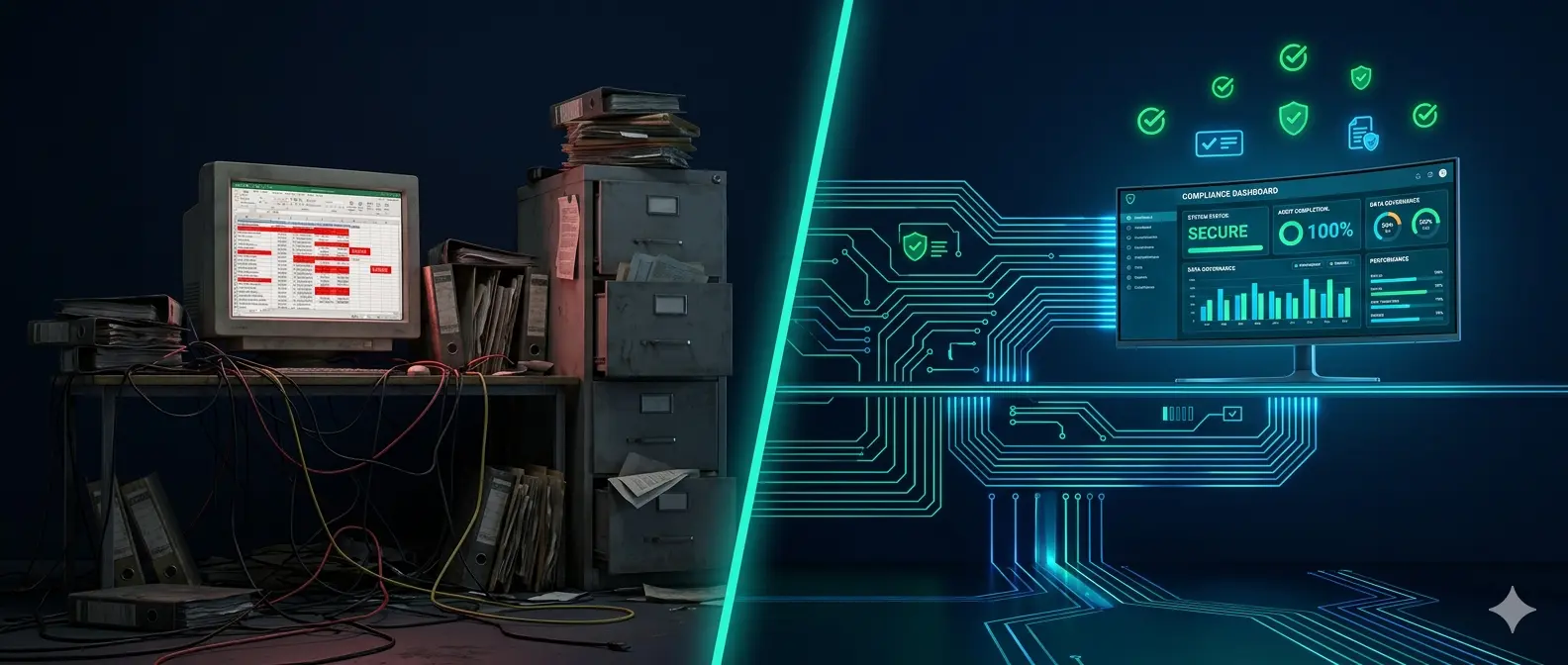
The old approach to SOC 2 looked like this: hire a consultant, spend three to six months manually documenting every policy and control, gather screenshots from a dozen systems into spreadsheets, engage an auditor, and pray the fieldwork goes smoothly. Total cost: anywhere from $50,000 to $150,000, with a significant share going to consulting fees and internal engineering time.
That model assumed manual evidence collection was the only option. It is not.
Modern GRC (Governance, Risk, and Compliance) platforms connect directly to your cloud infrastructure, identity providers, HR systems, code repositories, and security tools. They collect evidence automatically, continuously, and in real time. Platforms like Vanta now integrate with 350+ tools out of the box. The AICPA's own 2025 Trust Services Criteria updates explicitly favour continuous monitoring over point-in-time manual checks, acknowledging that the way security is operated today — in cloud-native, always-on environments — requires a different audit philosophy.
The result is a compliance program that does not stop when the auditor leaves. Your controls are monitored every day. Evidence is collected every day. When your audit window opens, you are already ready.
Instead of treating SOC 2 as a one-time project with a defined end date, treat it as a continuous operating capability that is active from day one.
Pro tip: Companies using AI-powered GRC platforms complete SOC 2 Type II audits 67% faster than those relying on manual processes, according to a 2025 Coalfire benchmark study. 80–90% of evidence collection is now automated. This is not a marginal efficiency gain — it changes the total cost structure entirely.
What it actually costs in 2026 — Type I and Type II 📊
The single biggest budgeting mistake founders make is pricing SOC 2 using figures from forums, blog posts, or advisors who haven't touched a compliance program since 2021. The numbers have moved. Here is what the market actually looks like in 2026.
SOC 2 Type I is a point-in-time assessment validating that your controls are properly designed as of a specific date. With a GRC platform already in place to automate readiness work, Type I auditor fees now range from $5,000–$25,000 and can be completed in four to eight weeks. For founders under deal pressure from a specific enterprise prospect, this remains your fastest unblocking mechanism.
SOC 2 Type II evaluates operating effectiveness over an observation period of three to twelve months. This is what enterprise procurement teams increasingly require, particularly in fintech, healthcare technology, and infrastructure SaaS. Auditor fees for Type II range from $15,000–$40,000 at boutique compliance-specialised firms, and $60,000–$100,000+ at Big Four firms. Total all-in program cost for a startup using a GRC platform typically lands between $25,000–$75,000 for the first year, significantly below the $100,000–$200,000 range that consultancy-led engagements quoted even two years ago.
The critical comparison:
Approach | First-year total | Timeline to Type II |
|---|---|---|
Traditional (consulting-led) | $80,000–$200,000 | 9–18 months |
GRC platform-led | $25,000–$75,000 | 4–9 months |
GRC + AI-powered platform | $20,000–$50,000 | 3–6 months |
Instead of asking "how do we minimise the cost of compliance," ask "which GRC platform gets us to audit-ready the fastest at the lowest total cost of ownership."

Breaking down every cost component 🔍
A complete SOC 2 program in 2026 involves five core cost categories. The weight of each has shifted significantly relative to what you would have read two years ago.
GRC platform subscription ($7,000–$30,000/year): This is now the backbone of your compliance program, not an optional add-on. Vanta and Drata typically start at $10,000–$15,000/year for startups. Secureframe starts around $7,500/year per framework. Sprinto is the most budget-accessible option for cost-sensitive early-stage companies. All of them automate evidence collection, run continuous control monitoring, and produce audit-ready reports. This subscription replaces what used to cost multiples of its price in consulting and internal engineering hours.
Readiness assessment ($3,000–$15,000): Your GRC platform automates a significant portion of gap identification through its integration-driven dashboards, reducing the scope of formal readiness consulting. Many startups complete their readiness entirely within their platform. If your environment is complex or you are pursuing multiple frameworks simultaneously, a focused advisory engagement of two to four weeks is sufficient.
Auditor fees ($5,000–$100,000): Type I with a boutique firm: $5,000–$15,000. Type II with a boutique compliance-specialised CPA: $15,000–$40,000. Big Four firms: $60,000–$100,000+ for Type II. The audit report that an enterprise procurement team accepts is identical regardless of the auditor firm's size. Select your auditor based on compliance specialisation and startup experience, not brand recognition.
Remediation and tooling ($5,000–$40,000): Closing control gaps identified during readiness. The range varies enormously based on your existing security posture. Companies with mature cloud-native infrastructure and active security tooling (SSO, MFA, MDM, SIEM) close gaps quickly and cheaply. Companies starting from scratch invest more here.
Penetration testing ($3,000–$20,000/year): Auditors require evidence of penetration testing. Focused web application tests start around $3,000. Full-stack infrastructure engagements run higher. Budget this as annual recurring, not one-time.
Pro tip: The total first-year cost for a startup using a GRC platform with a boutique auditor and a reasonably mature cloud environment should land between $25,000–$50,000. If you are being quoted significantly more, you are either over-scoping, using the wrong auditor, or still looking at a consulting-led model that the market has moved past.
The GRC-first approach: how automation changes the math 🤖
The most important thing to understand about SOC 2 in 2026 is that the GRC platform comes first — not the consultant, not the auditor, and not the policy templates.
You connect your platform to your infrastructure on day one. It immediately begins mapping your existing controls against SOC 2 requirements, flagging gaps, and collecting evidence. Within days, you have a live compliance dashboard showing exactly where you stand. Instead of a consultant spending weeks doing a gap analysis manually, your platform does it continuously and automatically.
This changes three things about the cost equation.
Timeline compression. With a GRC platform, startups with a reasonable security foundation can reach Type I audit-readiness in four to eight weeks and complete Type II observation in three to six months. Without one, timelines stretch to nine to eighteen months.
Internal time savings. Manual evidence collection — screenshots, spreadsheets, log exports, and access review documentation — consumed 50–100% of one team member's time under the traditional approach. Platforms automating 80–90% of evidence collection give that person back to the business. At a startup where every hire is fully allocated, this is not an abstract saving.
Continuous audit-readiness. Once your Type II is complete, you remain in continuous compliance. Annual recertification no longer requires a scramble — your platform has been collecting evidence and monitoring controls throughout the year. Subsequent audits cost 40–60% of the first engagement. Renewal fees drop significantly as auditors scope less fieldwork for organisations demonstrating year-round control evidence.
The platforms also now incorporate AI-native capabilities: automated risk scoring, intelligent remediation suggestions, AI-generated policy drafts, and automated vendor risk assessments. Platforms like Vanta, Drata, and Thoropass have all released AI-powered features that further compress readiness timelines.
The trust center shift. A major structural change in the market is the emergence of public trust centers — real-time, public-facing dashboards showing your compliance status, audit reports, and sub-processor list. These have become a sales tool, not just a compliance artifact. Instead of a security questionnaire that delays your deal by two weeks, your prospect checks your trust center and moves forward. 83% of enterprise buyers now require SOC 2 before signing SaaS contracts. Startups with public trust centers consistently report dramatic reductions in inbound security questionnaire volume — BARR Advisory, a leading SOC 2 audit firm, notes that companies with live trust centers see up to a 70% reduction in security questionnaire requests.
Instead of thinking of your GRC platform as a compliance cost, think of it as the infrastructure layer for enterprise readiness — the same way you think about your cloud hosting or payment processing stack.
What the right compliance partner looks like in 2026 🤝
Here is the question that naturally follows everything in the section above: if the platform does most of the work now, do you still need outside help? And if you do, what should that actually look like?
The honest answer is that you do not need a traditional compliance consultant. You need a different kind of partner entirely — one whose model is built around your platform, not around billing for the hours the platform has already eliminated.
The traditional consulting model charged you for gap analysis, policy writing, evidence collection preparation, and audit coordination. GRC platforms now automate most of that. A partner who still charges for those things in 2026 is selling you yesterday's value at today's prices.
Here is what a founder-first compliance partner looks like in the current environment, and why the distinction matters.
Platform-level cost benefits transfer directly to you. EIM operates as a platform partner with Vanta, Drata, Secureframe, and Sprinto. That relationship carries negotiated pricing that individual startups cannot access on their own. When we onboard you onto a platform, you benefit from those partner rates — the same platform, lower subscription cost, from day one. For a multi-year engagement, this saving alone often covers a meaningful portion of our advisory fee. You are not subsidising our margin on a platform we resell at a markup. The cost-benefit flows to you.
We operate as your fractional GRC team, not a project-based consultant. The traditional model had a clear exit: the consultant leaves when the audit report is issued. That exit is precisely where most compliance programs start falling apart — controls drift, evidence collection becomes inconsistent, and the next audit requires another expensive remediation sprint. EIM stays active inside your compliance program as a fractional team. We run your quarterly access reviews, manage your vendor risk assessments, monitor your control health dashboards, and flag gaps before they become audit findings. You get continuous compliance without hiring a full-time GRC function. For an early-stage startup where every headcount decision is consequential, this is the model that makes financial sense.
We compress your team's learning curve on the platform. A GRC platform is only as effective as the integrations you connect, the controls you configure, and the workflows your team adopts. Founders who onboard a platform without guidance often spend weeks figuring out the right control mapping, connecting integrations in the wrong sequence, or misunderstanding how observation periods interact with audit timing. We have run enough programs on each major platform to know exactly where startups lose time, what configurations matter most for your specific infrastructure, and how to get from zero to audit-ready in the shortest path. Your team spends their hours building product, not learning compliance tooling.
We take the auditor decision off your plate. Auditor selection is one of the highest-leverage decisions in your SOC 2 program — and one of the easiest to get wrong. The wrong auditor costs you 30–70% more than necessary. A generalist firm unfamiliar with SaaS startup environments runs longer fieldwork, asks more redundant questions, and creates friction your team does not need. We maintain active relationships with vetted boutique CPA firms that specialise in startup SOC 2 engagements, charge fair rates, and have the startup context to run efficient audits. We match you to the right firm for your size, infrastructure, and timeline — and we have already done the reference checking.
Instead of choosing between "do it yourself with a platform" and "hire a traditional consultant," choose a partner that runs your platform with you, keeps your program continuously healthy, and uses their position to reduce what you actually pay — not increase it.
Pro tip: The founders who overspend on SOC 2 in 2026 are not the ones who chose the wrong platform. They are the ones who either had no guidance choosing the platform, paid full retail on their subscription, selected the wrong auditor, or let their compliance program go dormant between audit cycles. Every one of those problems is preventable.
Hidden costs that still catch founders off guard ⚠️
Even with a GRC platform removing most of the manual friction, four cost categories consistently surprise first-time compliance programs.
Multi-framework overlap costs. Many founders discover mid-process that their target enterprise customers require not just SOC 2, but also ISO 27001, HIPAA, or GDPR compliance. The right GRC platform handles multiple frameworks from a shared control library — adding ISO 27001 alongside SOC 2 on Vanta or Drata is substantially cheaper than pursuing them sequentially or separately. If you know multi-framework is your destination, select a platform and scope your initial program with that in mind from day one.
Scope creep from AI and new product features. The AICPA's updated Trust Services Criteria now require organisations using AI systems to address model integrity, algorithmic bias, data poisoning risks, and training data lineage. If your product uses AI features — and most 2026 SaaS products do — your auditor will scrutinise these areas. Budget for the time and tooling to document and evidence your AI governance practices. This is new, and many founders are caught flat-footed.
Auditor selection mismatch. Founders who select auditors based on familiarity or a trusted referral rather than compliance specialisation pay 30–70% more than necessary. A boutique CPA firm that audits 200 SaaS companies per year will have more efficient, lower-cost fieldwork than a generalist firm seeing their third SOC 2 of the year. The credential on your report is identical.
Zero Trust architecture scrutiny. Auditors in 2025–2026 are examining access controls, network segmentation, and least-privilege enforcement more intensively than in previous years. If your infrastructure was not built with Zero Trust principles, remediation work can be more extensive than a readiness assessment initially suggests. Catch this early.
Turning your SOC 2 investment into a revenue asset 💼
83% of enterprise buyers require SOC 2 certification before signing SaaS contracts. 67% of startups that achieved certification report that it directly enabled deal closures. 34% of organisations without SOC 2 have lost deals specifically because they lacked certification. These are not soft signals — they are the buying criteria of your target market.
The framing that still appears in too many compliance conversations is defensive: we need SOC 2 because customers are asking for it. The more accurate framing is commercial: SOC 2 compresses your sales cycle, removes the most common enterprise deal-blocker, and converts your security posture from a liability narrative into a competitive advantage.
According to Vanta's 2025 State of Trust report, security compliance has become a direct revenue driver for certified companies — not merely a risk management function. For a startup with a six-month enterprise sales cycle, removing the security review stage from procurement translates to a material increase in revenue per sales rep per year.
Quickly Technologies is a live example in our own client base. After achieving both ISO 27001 and SOC 2 Type 2 with EIM Services in seven months, their public trust center removed security review delays that had previously added weeks to enterprise payment processing contract negotiations. Compliance became a sales asset, not a procurement barrier.
Instead of calculating the cost of SOC 2, calculate the cost of the deals you are currently losing or delaying because you don't have it.
Planning for continuous compliance — not annual scrambles 🔄
The old model of SOC 2 compliance had a clear lifecycle: prepare, audit, receive report, forget about it for eleven months, scramble again before renewal. That model is incompatible with how enterprise buyers evaluate vendors in 2026.
Buyers increasingly request real-time access to your compliance status, not a PDF from eight months ago. Audit periods are shortening. New Trust Services Criteria around AI governance, Zero Trust, and cloud security require ongoing operational attention, not annual check-ins.
The companies that manage ongoing SOC 2 costs most efficiently are the ones running their GRC platform as live operational infrastructure — controls monitored daily, evidence collected automatically, policies reviewed quarterly as part of business rhythm rather than as an audit-triggered event.
Annual recertification audits with a GRC platform in place typically cost 40–60% of the initial engagement. Your auditor scopes less fieldwork because your continuous evidence collection demonstrates year-round control operation. A sustained annual maintenance budget of $15,000–$35,000 covers platform subscription, annual penetration test, and recertification audit fees for most startups.
Combining your SOC 2 maintenance with ISO 27001 certification or GDPR compliance through the same GRC platform leverages shared controls and reduces the marginal cost of each additional framework substantially. A company maintaining three frameworks on a single platform spends far less than one maintaining each framework separately.
Building governance through ISO 42001 certification alongside your SOC 2 program is increasingly relevant for companies whose products touch AI systems — AICPA's updated TSC explicitly addresses AI governance, and ISO 42001 provides the management system structure that supports it.
Instead of seeing annual surveillance as a recurring disruption, see continuous compliance as the operational standard that enterprise customers depend on — and that your competitors who haven't invested yet cannot match.
FAQs ❓
How does SOC 2 compare to ISO 27001 in 2026? SOC 2 validates specific security controls for North American markets. ISO 27001 establishes a comprehensive information security management system with global recognition. The two frameworks share significant control overlap, and the most efficient path for companies targeting both North American and international enterprise markets is to pursue them simultaneously on a shared GRC platform. Schedule a free consultation to map the right sequencing for your target customers.
What is the fastest path to SOC 2 in 2026? Deploy a GRC platform on day one. Use it to run an automated gap assessment against your existing infrastructure. Close your highest-priority gaps, then initiate a Type I audit with a boutique compliance firm. Companies with an existing cloud-native security foundation can reach Type I audit-readiness in four to eight weeks. Book a consultation for a timeline scoped to your specific environment.
Which GRC platform should we use? Platform selection depends on your infrastructure complexity, existing integrations, and budget. Vanta and Drata are the most mature options for scaling SaaS companies. Secureframe offers strong mid-market value. Sprinto is the most cost-accessible option for early-stage startups. The wrong choice costs you months of re-onboarding later. As platform partners, we can onboard you at negotiated pricing across all major platforms and match the right tool to your environment from day one — connect with us before you subscribe.
Do we need to address AI governance in our SOC 2? If your product uses AI features — including third-party AI APIs integrated into your workflows — yes. The AICPA's updated 2025 Trust Services Criteria require organisations to address AI model integrity, bias, and data governance. Auditors are actively scrutinising these areas. Plan for it from the start of your readiness program.
How much does annual recertification cost? With a GRC platform maintaining continuous evidence collection, annual Type II recertification typically costs 40–60% of your initial audit engagement. Budget approximately $15,000–$35,000 annually for platform subscription, penetration testing, and recertification audit fees for most startups. Connect with us for a precise annual estimate.
When does the investment pay for itself? 67% of startups that achieved SOC 2 report that it directly enabled specific enterprise deal closures. For most of our clients, the investment is recovered in full from the first or second enterprise contract it unblocks or accelerates. When you factor in the accelerated deal cycles that come from removing security review delays, the ROI case is straightforward.
Book a free consultation 📞
If you are a founder navigating SOC 2 for the first time, the single most valuable conversation you can have costs nothing. Not because we want to sell you something — but because the decisions you make in the first two weeks of a compliance program determine 80% of what you end up paying. Platform selection. Audit scope. Auditor choice. Framework sequencing. Getting these right from the start is worth more than any optimisation you can apply later.
We work alongside your GRC platform as a fractional compliance team: helping you select the right platform at partner pricing, configuring it for your specific infrastructure, running your continuous compliance operations so your team stays focused on the product, and connecting you with the right auditor for your size and timeline. Our model is built to reduce what you pay, not add to it.
Book a free consultation — 30 minutes, no obligation, and you will leave with a clear picture of what your program should cost and how long it should take.
Oleg Co-Founder @ EIM
Serving the startup community since 2024, 20+ years in Enterprise
EIM Services has partnered with multiple Canadian and International startups to deliver scalable, cost-effective, and solid solutions. Our expertise spans pre-seed to Series A companies, delivering modern continuous certification and compliance solutions tailored for Startups in the cost-effective and shortest possible time. As well as bringing automated financial systems that reduce financial overhead by an average of 50% while ensuring investor-grade reporting at a fraction of the cost of an in-house team. We've helped startups save thousands through strategic financial positioning and compliance excellence.
